What the Bujinkan Weapons System Really Is
At its heart, the Bujinkan is a collection of nine old Japanese schools, each carrying fragments of history—battlefields, survival strategies, and lessons refined through generations. When you step into weapons training, you’re not just learning how to swing something. You’re stepping into a system that was built for real conflict, real unpredictability.
And here’s the subtle shift most people miss: the weapon is never the focus. Your movement is.
Weapons Are Just Extensions of You
Pick up a staff, a sword, or even a small blade—the principle doesn’t change. The same body mechanics apply. The same timing matters. The same awareness determines whether you succeed or fail.
That’s why someone skilled in Bujinkan doesn’t “switch modes” when holding a weapon. They simply extend what they already are.
The Core Traditional Bujinkan Weapons
Some tools show up again and again in training—not because they look impressive, but because they teach something essential.
The Rokushakubō (Six-Foot Staff)
Long, simple, and deceptively powerful.
The bo forces you to understand distance. If you misjudge space by even a few inches, everything falls apart. Over time, it sharpens your awareness until you can feel range without thinking.
The Hanbō (Half Staff)
Shorter. Tighter. More personal.
The hanbō lives in that uncomfortable middle distance—too close for big swings, too far for simple grappling. It teaches control, leverage, and how to dominate space without needing brute force.
The Tantō (Knife)
This is where things get serious.
A blade changes everything. Suddenly, precision matters more than power. Small mistakes become big consequences. Training here builds a kind of awareness that sticks with you—because it has to.
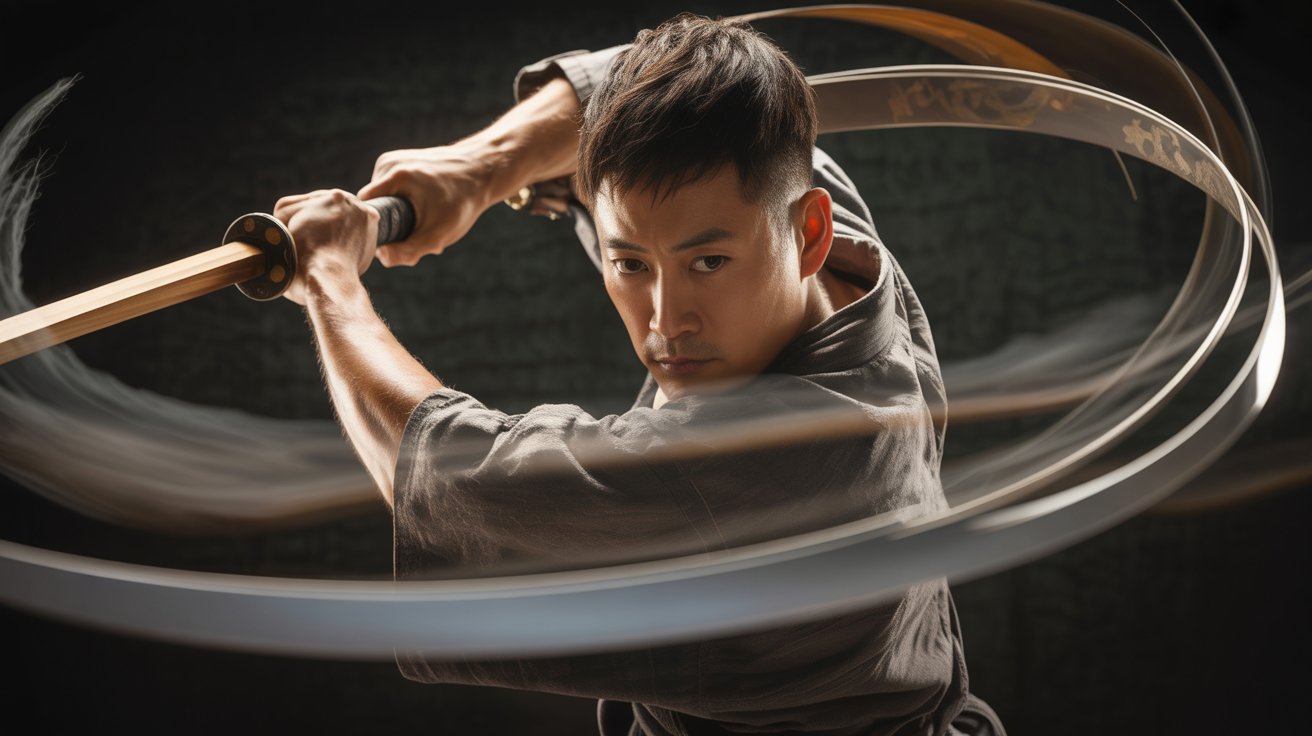
The Katana (Sword)
There’s a reason the sword is so iconic—but in Bujinkan, it’s not about elegance or display.
It’s about timing.
A perfectly timed movement beats strength every time. The sword simply makes that truth impossible to ignore.
Short Blades (Wakizashi and Others)
When space disappears, these come into play.
They teach you how to function under pressure—tight environments, fast decisions, no room for error.
Yari (Spear)
Long reach. Direct intention.
The spear teaches you to control the fight before it begins. Whoever owns the distance controls the outcome.
Naginata (Polearm)
Wide, flowing, almost circular in nature.
It forces your body to move differently—less rigid, more continuous. You begin to understand how motion itself becomes a weapon.
The Unpredictable Weapons
Then there are the tools that refuse to behave.
Kusari Fundo (Chain Weapon)
Flexible. Unforgiving. Honest.
You can’t fake control with a chain. It exposes hesitation instantly and demands full awareness of space.
Kyoketsu Shoge
Part blade, part rope, part chaos.
It’s not just a weapon—it’s a system of possibilities. Trapping, pulling, redirecting… it teaches you to think in multiple directions at once.
Shuriken
Not what most people think.
These aren’t meant to “win fights.” They disrupt. They distract. They create moments—and in those moments, everything changes.
The Hidden Side of Ninjutsu
Some tools don’t look like weapons at all.
Blinding powders. Small hand implements. Climbing gear.
They exist for one reason: survival.
Because in the end, the goal was never to “fight well.” It was to get out alive.
Why This Training Feels Different
Spend enough time in Bujinkan, and something shifts.
You stop collecting techniques. You start noticing patterns.
Flow Replaces Memorization
Instead of trying to remember what to do, your body begins to respond naturally. Movement becomes less about thinking and more about recognizing.
Distance, Timing, Angles
Everything comes back to these.
Not the weapon. Not the technique. Just your ability to read space, act at the right moment, and move in the right direction.
One System, Not Many
Empty hand. Sword. Staff. It’s all the same conversation—just spoken with different tools.
Then vs Now
Of course, modern training isn’t identical to the past.
We use safer equipment. We train in controlled environments. Some context is lost.
But the core? That’s still there.
The movement. The timing. The mindset.
Those haven’t changed.
FAQs (The Questions People Actually Ask Themselves)
Where should I even start?
Start with the staff. It teaches you everything you didn’t realize you were missing.
Are these weapons useful today?
The tools may change—but the principles don’t. And those are what matter.
Do I need real weapons?
No. In fact, you shouldn’t. Skill comes from understanding, not danger.
Products / Tools / Resources
If you’re stepping into Bujinkan weapons training, a few essentials make the process smoother—and safer:
-
Wooden bokken (training sword) for safe katana practice
-
Rattan or hardwood bo staff for durability and grip
-
Foam or rubber tantō for controlled blade training
-
Practice hanbō for close-range drills
-
Training shuriken (rubber or padded) for accuracy work
Each of these tools isn’t just equipment—they’re entry points into understanding how the system really works.