The katana and the tachi are often treated like twins—two elegant Japanese swords separated only by name. But that assumption misses something deeper. These blades weren’t just weapons. They were answers to completely different problems.
If you trace their origins carefully, you begin to see it: the tachi belongs to a world of mounted warriors and sweeping battlefield movements, while the katana emerges from something tighter, faster, more immediate. A different kind of violence. A different kind of survival.
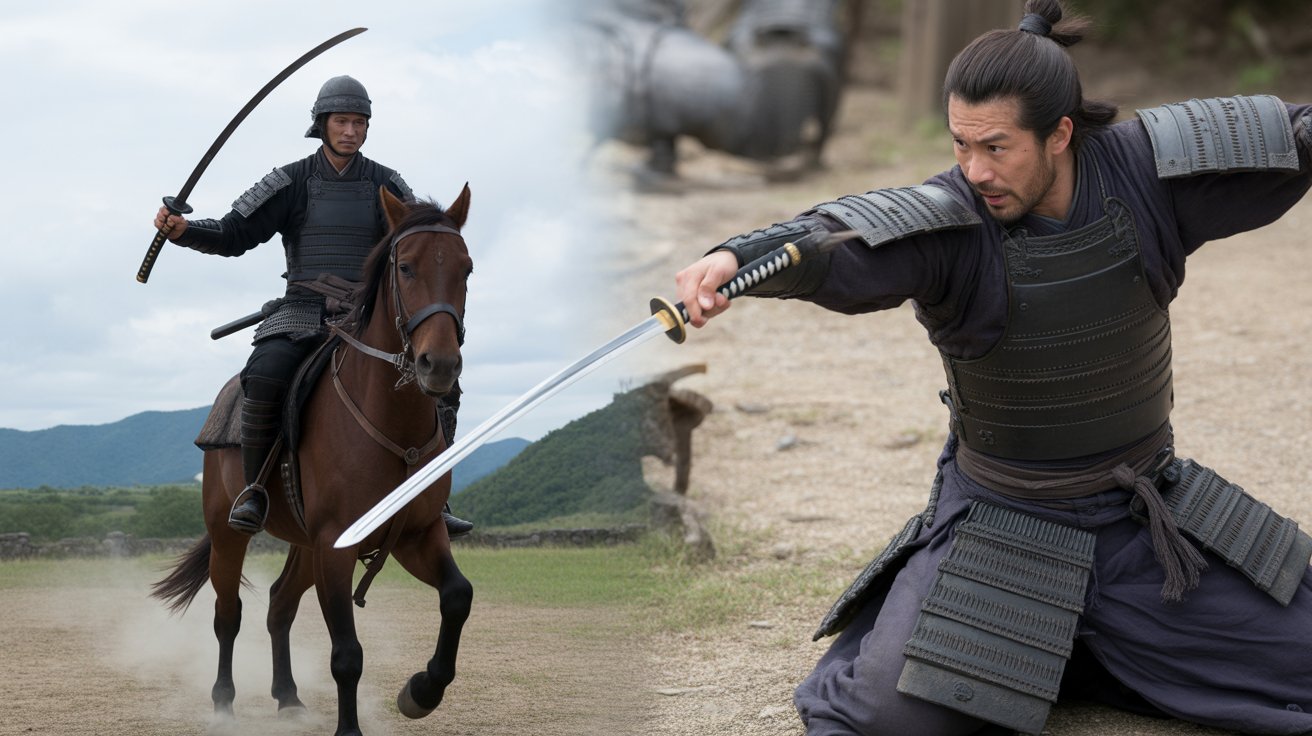
The tachi came first. It was built for a time when samurai fought primarily on horseback, where space and motion defined everything. Its curve wasn’t decorative—it was a solution. When a rider struck from above, that deeper arc allowed the blade to glide through a target with minimal resistance. Even the way it was worn—edge facing down, hanging from cords—was designed for that specific rhythm of combat.
Then the battlefield changed.
By the Muromachi period, warfare had compressed. Fewer cavalry charges, more ground fighting. Closer encounters. Less time to react. In that environment, the tachi began to feel… slow.
That’s where the katana takes over.
Worn edge-up, tucked into the belt, it could be drawn and used in a single motion. Not just faster—decisively faster. Entire techniques were built around this idea. The draw became the strike. And in a fight where hesitation meant death, that subtle shift made all the difference.
Physically, the differences between the two swords seem small until you understand what you’re looking at. The tachi tends to have a deeper curve, optimized for long, flowing cuts. The katana’s curve is more restrained, giving it tighter control in close quarters. One favors reach and momentum. The other favors speed and precision.
Even the signature on the blade—the mei—tells a story. Swordsmiths positioned it differently depending on whether the blade was meant to hang edge-down or sit edge-up. It’s a quiet detail, easy to miss, but it reveals how deeply function influenced form.
So which one was better?
That question doesn’t quite land. The tachi was better for its time. The katana was better for what came next. Each blade is perfectly tuned to the kind of war it was meant to survive.
Over time, though, the katana became something more than just practical. It moved closer to identity. Samurai carried it daily. Lived with it. It became personal in a way the tachi never quite did.
That’s part of why the katana dominates modern imagination. It’s not just a weapon—it’s a symbol.
Meanwhile, the tachi lingers in the background. Older. More ceremonial. Still respected, but no longer central.
And today, the line between them is often blurred. Blades have been remounted. Labels have been lost. Pop culture tends to flatten everything into a single image. So the distinction fades unless you know where to look.
But once you see it, you can’t unsee it. The angle of the curve. The direction of the edge. The intention behind the design.
Two swords. Two eras. Two completely different philosophies of combat.
Products / Tools / Resources
- Traditional Japanese sword anatomy diagrams for visual identification
- Books on samurai history and weapon evolution
- Museum collections (digital archives) featuring authenticated blades
- Reproduction katana and tachi for educational comparison
- Documentaries on Japanese swordsmithing and metallurgy
- Online courses