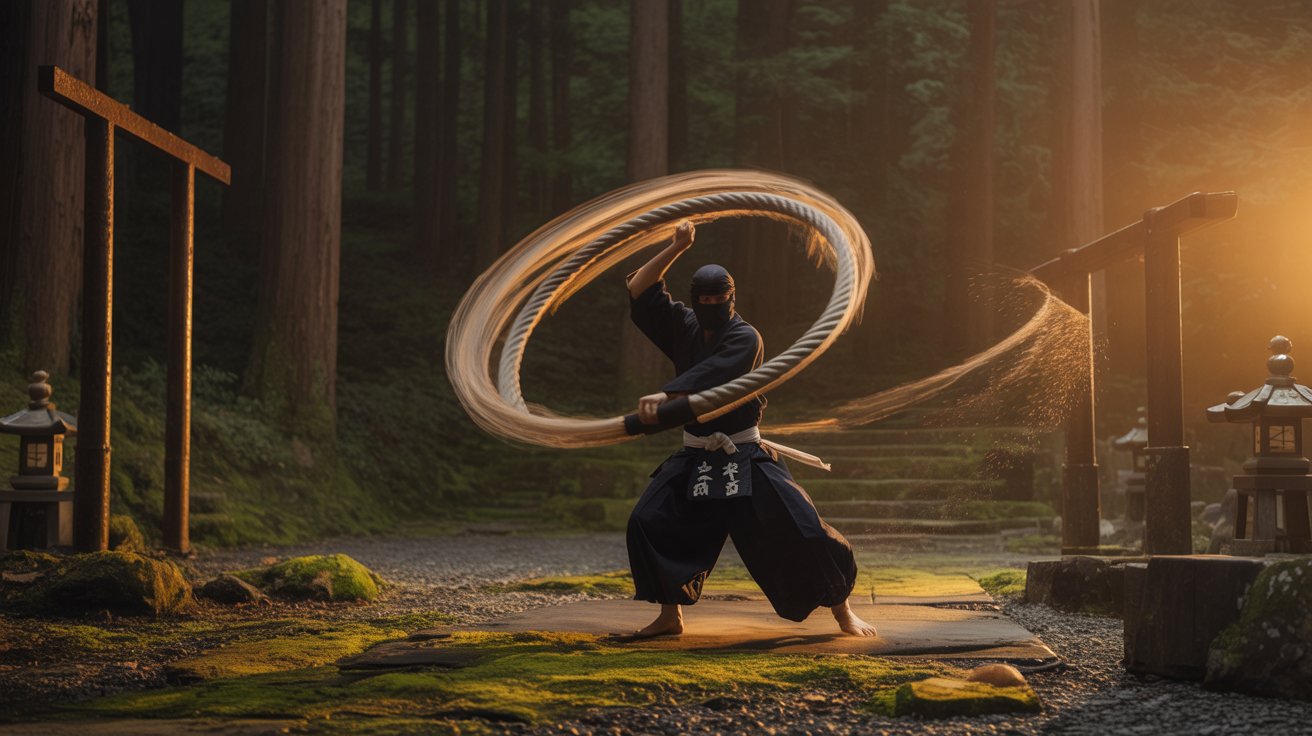
Among the many weapons connected to classical ninjutsu, few spark as much curiosity as the kyoketsu shoge. At first glance it seems unusual—part dagger, part rope weapon, part grappling tool. Yet within the training traditions preserved in the Bujinkan, this weapon represents something deeper than an exotic piece of martial arts history.
It represents adaptability.
Where rigid weapons rely on direct force, the kyoketsu shoge thrives on movement, timing, and creativity. It bends around defenses. It manipulates distance. It allows a practitioner to disrupt an opponent without ever committing to a single line of attack.
To someone unfamiliar with it, the weapon looks chaotic. To a trained practitioner, it is a system of control—one that turns rope, steel, and momentum into a surprisingly sophisticated combat tool.
Understanding the Kyoketsu Shoge
Before discussing techniques, it helps to understand what makes this weapon unique.
The Three Parts of the Weapon
The kyoketsu shoge is deceptively simple, consisting of three components.
The Blade (Shoge)
A short dagger with a distinctive hook near the base. The blade can cut, but the hook is equally important—it allows the practitioner to catch clothing, trap limbs, or control another weapon.
The Rope or Cord
Usually several meters long, the rope connects the blade to the ring. This cord transforms the weapon from a simple dagger into something far more dynamic.
With the rope, the practitioner can manipulate distance, pull opponents off balance, or wrap the weapon around limbs.
The Metal Ring
At the opposite end sits a heavy metal ring. The ring acts as a counterweight, allowing the rope to spin with speed and stability. It can also be used to strike, hook objects, or redirect the rope’s motion.
Together, these pieces create a weapon that can strike, trap, pull, or entangle, depending entirely on how the practitioner moves.
Why the Weapon Fits the Ninjutsu Mindset
Traditional ninjutsu favored tools that were flexible and adaptable.
Instead of relying on brute strength, practitioners emphasized:
-
positioning
-
timing
-
deception
-
environmental awareness
The kyoketsu shoge embodies those ideas perfectly.
A straight sword demands a direct line of attack. A spear moves forward and back.
The kyoketsu shoge, however, moves in every direction at once.
It can circle an opponent, redirect momentum, wrap around obstacles, or strike from angles that are difficult to anticipate.
This unpredictability is exactly what made it valuable within traditions preserved in the Bujinkan training system.
Movement Principles Behind Kyoketsu Shoge Techniques
Trying to memorize techniques without understanding the movement principles usually leads to frustration. Flexible weapons require a different mindset than rigid ones.
Distance Becomes a Weapon
The rope dramatically extends reach.
Instead of stepping directly into danger, the practitioner can remain outside striking range and still influence the fight.
The rope can:
-
wrap around a limb
-
strike with the ring
-
pull the opponent off balance
Distance control becomes one of the weapon’s most powerful advantages.
Circular Motion Creates Momentum
Rigid weapons often move in straight lines.
The kyoketsu shoge rarely does.
Most techniques rely on circular motion. Spinning the rope creates momentum, and momentum makes the weapon responsive.
Once the rope begins moving in circles, the practitioner can redirect that energy in many ways—striking, trapping, or wrapping the rope around a target.
Flow Over Fixed Technique
A defining feature of training in the Bujinkan tradition is fluidity.
Rather than memorizing rigid patterns, practitioners learn to transition naturally between actions.
A motion that begins as a spin might become a strike.
A strike might turn into a wrap.
A wrap might become a pull.
The weapon rewards adaptability.
Foundational Bujinkan Kyoketsu Shoge Techniques
Once these movement principles are understood, practitioners begin working on foundational techniques.
These techniques build control, awareness, and coordination.
Rope Entanglement
One of the most recognizable applications of the weapon is entanglement.
The rope can loop around an opponent’s arm, wrist, or leg. Once the rope catches the limb, a quick pull can disrupt balance or restrict movement.
The technique is less about strength and more about timing and angle.
A well-timed wrap can immobilize an opponent far more effectively than a direct strike.
Ring Striking Techniques
The metal ring may look like a simple counterweight, but it can be surprisingly effective as a striking tool.
When swung with momentum, the ring can target areas such as:
-
the hands
-
the collarbone
-
the ribs
-
the side of the head
These strikes are often used to create brief openings. A quick impact can disrupt an opponent’s focus just long enough to transition into another technique.
Hooking and Trapping With the Blade
The hook on the blade allows for subtle trapping actions.
Instead of cutting immediately, the practitioner might use the hook to:
-
catch a sleeve
-
trap a wrist
-
redirect a weapon
Once the hook connects, the rope allows leverage that can manipulate the opponent’s position.
The movement becomes less about attacking and more about controlling the opponent’s structure.
Advanced Tactical Concepts
After gaining control of the basics, practitioners start exploring how the weapon behaves in more complex situations.
Layering Multiple Threats
One advantage of the kyoketsu shoge is that it can threaten an opponent in more than one way at the same time.
For example, the rope might wrap a wrist while the ring swings toward the opponent’s shoulder.
The blade may follow immediately afterward.
Instead of a single attack, the opponent faces a sequence of unpredictable movements.
Disarming an Opponent
Flexible weapons are excellent tools for disrupting other weapons.
The rope can catch around a stick, sword, or arm. Once tension is applied, the practitioner can pull or redirect the weapon’s motion.
The goal is rarely to overpower the opponent. Instead, the technique focuses on removing stability from the opponent’s grip.
Using the Environment
Another interesting aspect of the weapon is how it interacts with surroundings.
The ring can hook around branches, beams, or other structures. Doing so changes the angle and momentum of the rope.
In historical contexts, this made the weapon useful for climbing or maneuvering through complex environments.
Even in modern training, exploring environmental interaction reveals just how versatile the weapon can be.
Training the Kyoketsu Shoge Safely
Because the weapon combines a rope and blade, training must progress carefully.
Solo Coordination Drills
Most beginners begin with simple rope control drills.
These include:
-
spinning patterns
-
rope recovery movements
-
ring momentum control
These exercises build the coordination needed to manage the weapon safely.
Partner Flow Drills
Once the basics feel natural, training begins with partners.
Instead of aggressive sparring, the focus is usually on controlled movement:
-
gentle rope wraps
-
balance disruption
-
timing exercises
The goal is to develop sensitivity to movement.
Gradual Equipment Progression
Training tools often start as soft or wooden replicas.
Only after practitioners gain significant control do they transition to equipment that more closely resembles the historical weapon.
This progression keeps training safe while preserving realism.
Comparing the Kyoketsu Shoge to Other Rope Weapons
The kyoketsu shoge is sometimes compared to the famous kusarigama.
Although both weapons use flexible chains or ropes, their emphasis differs.
The kusarigama pairs a sickle with a chain and weighted end, often focusing on weapon entanglement and cutting attacks.
The kyoketsu shoge, however, leans heavily into versatility.
It can strike, trap, pull, wrap, climb, and redirect movement.
Because of this flexibility, it often feels less like a single weapon and more like a small system of tools connected by a rope.
The Fascination With This Rare Weapon
Even among martial artists, the kyoketsu shoge remains relatively rare.
Part of its appeal lies in the challenge it presents. Flexible weapons demand coordination, patience, and creativity.
They cannot be forced into rigid technique.
Practitioners who explore its methods often discover something unexpected: learning the weapon teaches more than mechanical skill.
It sharpens awareness of timing, distance, and movement.
In that sense, the kyoketsu shoge reflects a deeper lesson embedded within traditions preserved by the Bujinkan—the idea that true effectiveness in martial arts often comes not from overpowering an opponent, but from understanding how movement itself can be controlled.
Products / Tools / Resources
For martial artists interested in exploring kyoketsu shoge training, a few resources can make practice safer and more productive:
Training Kyoketsu Shoge (Wood or Rubber Versions)
Replica training weapons allow practitioners to practice rope movement and coordination without sharp blades.
Heavy Rope Training Tools
Practicing rope manipulation with weighted ropes can improve control before transitioning to the actual weapon.
Flexible Weapon Training Guides
Books and instructional material on traditional ninjutsu weapons can provide insight into historical methods and training drills.
Martial Arts Training Mats
Since many rope techniques involve pulling or off-balancing, having proper mats reduces injury risk during partner training.
Taught by Doshi Richard Van Donk – personal student of Grandmaster Dr. Masaaki Hatsumi.