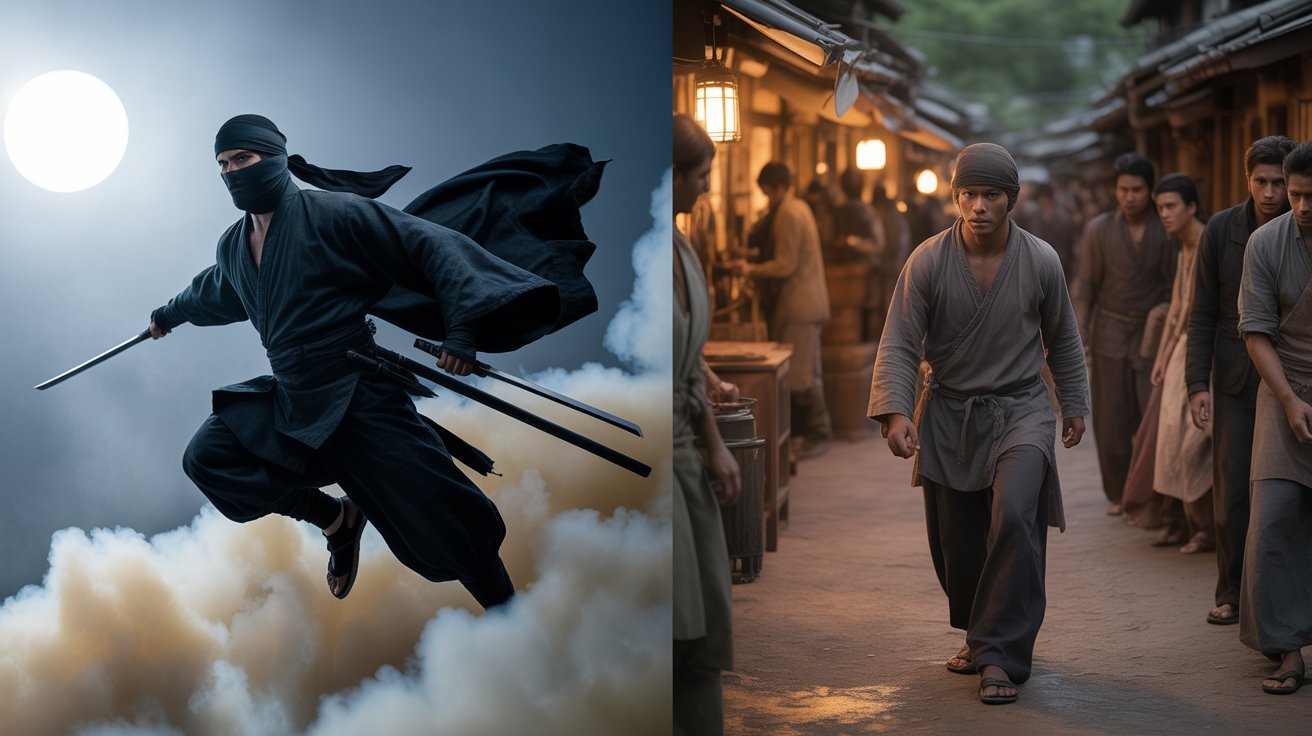
Close your eyes and picture a ninja.
Chances are, you see black robes, impossible flips, blades flashing in moonlight, and a body that vanishes in a puff of smoke. That image didn’t come from history. It came from screens.
Movies didn’t just exaggerate ninjutsu—they rebuilt it into something louder, faster, and far less human. And in doing so, they buried a reality that’s quieter, sharper, and far more unsettling than fantasy.
Because real ninjutsu was never about looking powerful.
It was about staying alive.
How the Movie Ninja Was Born
The cinematic ninja didn’t crawl out of ancient scrolls. It stepped onto a stage.
In traditional Japanese theater, stagehands wore black so the audience would ignore them. They were meant to fade into the background. When one of those “invisible” figures suddenly became part of the story, the effect was electric. Surprise. Tension. Control.
Film inherited that visual trick and never let it go.
By the time ninjas hit Western cinema, subtlety was gone. Black outfits became uniforms. Silence became superpowers. Strategy was replaced by spectacle because spectacle is easy to sell. A quiet decision made days earlier doesn’t thrill an audience. A spinning kick does.
Hollywood didn’t misunderstand ninjutsu.
It redesigned it.
What Ninjutsu Really Was
Strip away the fantasy and ninjutsu stops looking like a martial art. It starts looking like a system.
Historically, ninjutsu existed to solve one problem: how to survive and succeed in hostile territory without being noticed. That meant gathering information, moving without raising suspicion, and escaping before anyone realized something had gone wrong.
Combat was a last resort.
Victory meant returning home.
Real ninjutsu focused on:
-
Awareness over aggression
-
Timing over speed
-
Psychology over strength
-
Adaptation over fixed technique
A shinobi didn’t want to win a fight. They wanted to make sure the fight never happened.
The Role of the Ninja in Real History
The word “ninja” itself is misleading. Historically, these practitioners were called shinobi—people who endured, concealed, and adapted.
They weren’t lone assassins in black. They were scouts, messengers, infiltrators, and specialists operating in unstable political landscapes. Their greatest weapon wasn’t a blade. It was anonymity.
Disguise mattered more than intimidation.
Blending in mattered more than standing out.
The most successful shinobi were the ones no one ever noticed.
Weapons: What Movies Get Wrong
Movies love exotic tools. Shuriken fly constantly. Swords appear in every scene. Combat is unavoidable.
Reality was less glamorous.
Weapons were often improvised. Tools served specific purposes—distraction, delay, escape—not domination. Shuriken, for example, were rarely meant to kill. They were thrown to create hesitation, break focus, or force distance.
If a tool made noise or drew attention, it was a liability.
Real ninjutsu favored function over form. If something worked, it stayed. If it didn’t, it was discarded—no matter how impressive it looked.
Stealth Isn’t Invisibility
In movies, stealth means darkness, smoke, and vanishing acts.
In real life, stealth is psychological.
It’s knowing when people stop paying attention.
It’s understanding how sound travels.
It’s reading patterns—guards, routines, human habits.
True stealth doesn’t hide you.
It makes you irrelevant.
The goal isn’t to disappear. It’s to never register as a threat in the first place.
Why Hollywood Needed to Get It Wrong
Entertainment demands clarity. Good guys fight. Bad guys fall. Power is visible.
Real ninjutsu offers none of that. Its successes are invisible. Its victories often look like nothing happened at all.
That doesn’t translate well to film.
So complexity was flattened. History was compressed. Over time, repetition turned exaggeration into “truth.” Audiences learned what to expect, and filmmakers delivered exactly that.
Fantasy fed expectation.
Expectation erased reality.
The Missing Piece: Psychological Warfare
What movies almost never show is the mental game.
Real ninjutsu invested heavily in fear, confusion, and uncertainty. The objective wasn’t to overpower an enemy—it was to destabilize them. Make them doubt what they saw. Make them hesitate. Make them waste energy reacting to the wrong threat.
Sometimes the most effective move was doing nothing at all and letting the opponent unravel on their own.
That kind of power doesn’t look exciting.
But it works.
Ninjutsu in the Modern World
Authentic ninjutsu didn’t vanish. It survived quietly through lineages and schools such as Bujinkan, Genbukan, and Jinenkan.
Modern training doesn’t resemble movie choreography. Movements are understated. Techniques look almost ordinary. That’s intentional.
The focus remains on:
-
Body awareness
-
Balance and control
-
Reading intent
-
Adapting under pressure
And while no one is sneaking through castles anymore, the principles still apply. Awareness in public spaces. Avoiding unnecessary conflict. Understanding how people move, think, and react when stressed.
In that sense, real ninjutsu is less about fighting—and more about navigating life without becoming a target.
Why the Real Story Is Better Than the Fantasy
Movie ninjas feel powerful because they’re impossible.
Real ninjutsu is powerful because it accepts reality—human limits, uncertainty, and risk—and works intelligently within them.
It doesn’t shout.
It doesn’t show off.
It endures.
And that truth, once you see it, is far harder to forget than any special effect.
Products / Tools / Resources
-
Books on historical ninjutsu and shinobi culture
-
Training organizations such as Bujinkan, Genbukan, and Jinenkan
-
Situational awareness and self-protection education
-
Traditional Japanese martial arts schools with verified lineage
- Legitimate Bujinkan Ninjutsu Online Courses