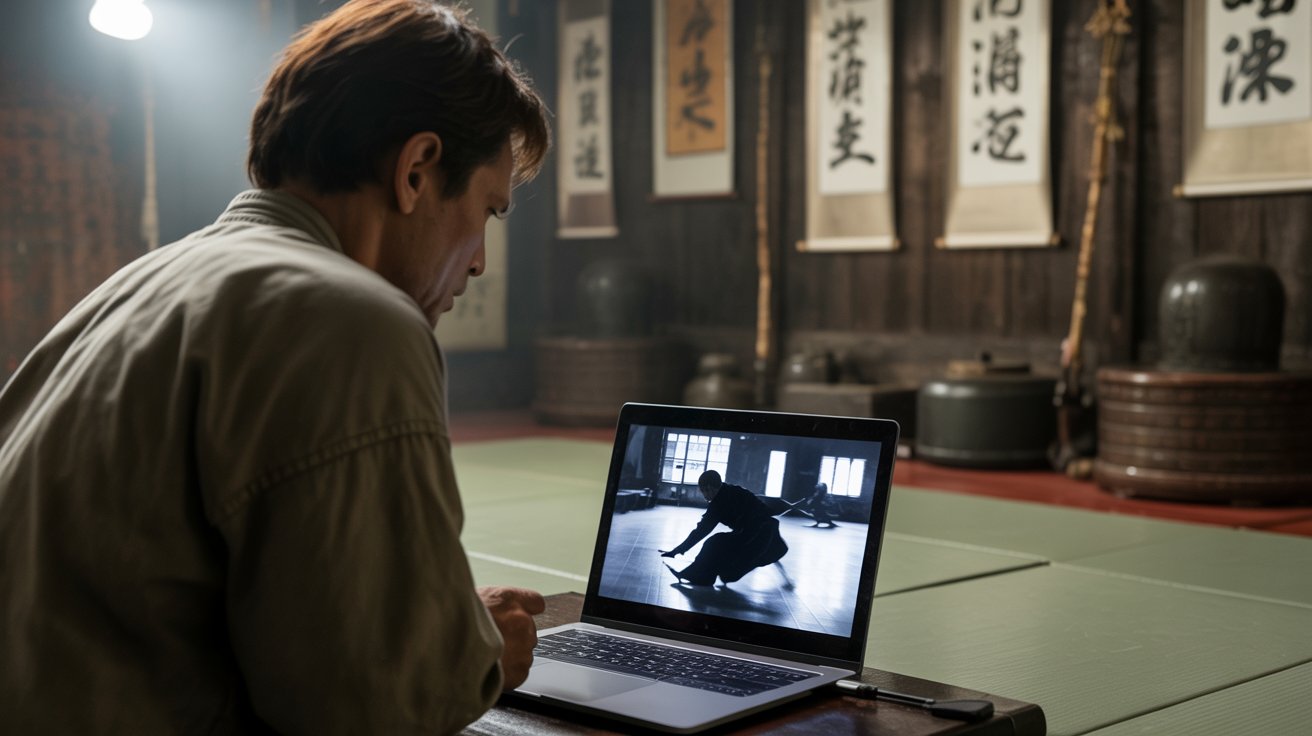
There’s a quiet tension that comes up whenever the subject of online training enters traditional martial arts circles. Bujinkan Budō Taijutsu, in particular, seems to resist the idea. It isn’t loud or rigid. It doesn’t rely on muscular force or memorized sequences. It lives in balance, timing, distance, and something harder to describe — feeling.
So when people search for how to learn Bujinkan Budō Taijutsu online, what they’re really asking is something deeper:
Is it possible to train sincerely without betraying the art itself?
The answer isn’t found in shortcuts or promises of mastery from a screen. It’s found in understanding what Budō Taijutsu actually demands from the practitioner — and how modern tools can support that process when used correctly.
What Bujinkan Budō Taijutsu Is — and What It Is Not
Before any discussion about online learning makes sense, the art itself needs to be clearly understood. Most confusion around online training comes from misunderstanding what is being trained in the first place.
Taijutsu Is Not a Collection of Techniques
Despite the way it’s often presented online, Budō Taijutsu is not a catalogue of techniques to be copied. Techniques exist, but they are expressions of principles, not the goal.
At its core, taijutsu is about how the body moves naturally under pressure. How posture changes when balance is threatened. How distance collapses or expands. How timing disrupts intent before strength ever comes into play.
This is why two people can perform the same kata and yet one looks effortless while the other looks forced. The difference isn’t knowledge — it’s embodiment.
Why “Ninjutsu” Creates Confusion
The word “ninjutsu” attracts curiosity, but it also creates distortion. Within the Bujinkan, some schools have historical roots associated with shinobi traditions, while others come from classical samurai lineages. What unifies them is not stealth or theatrics, but body mechanics and strategy.
When online training focuses on surface imagery instead of movement quality, the art loses its depth. Authentic learning — online or otherwise — always returns to taijutsu.
Can You Really Learn Bujinkan Budō Taijutsu Online?
This question deserves an honest, grounded answer rather than an ideological one.
What Online Training Can Develop Well
When approached correctly, online training can meaningfully develop:
-
Natural posture and alignment
-
Basic kamae and transitional movement
-
Ukemi and body conditioning
-
Awareness of distance and angling
-
Conceptual understanding of balance and timing
-
The ability to see correct movement more clearly
These are not minor things. They form the foundation of all higher-level practice.
What Online Training Cannot Replace
What online learning cannot fully provide is tactile feedback. Feeling resistance. Experiencing unpredictability. Having a teacher physically adjust your balance or structure.
That doesn’t make online training invalid — it simply defines its role. Online study supports preparation, refinement, and continuity. It does not replace live transmission, but it can make in-person encounters far more productive when they happen.
How Legitimate Online Taijutsu Training Actually Works
Productive online training looks quiet from the outside. There are no dramatic leaps or fast results. Progress happens subtly, often noticed only in hindsight.
Training the Body Before the Technique
Most credible online instruction emphasizes basics relentlessly. Standing. Stepping. Turning. Shifting weight without tension. These movements are repeated slowly, sometimes to the point of frustration.
That frustration is important. It exposes habits that would otherwise be masked by speed or strength.
Taijutsu begins to emerge when movement becomes economical and unforced — when balance is maintained even while changing direction.
Studying Video the Right Way
Watching video casually teaches very little. Studying video deliberately can teach a great deal.
This means watching short sections repeatedly. Paying attention to hips, spine, and foot placement rather than hands. Practicing in silence. Recording yourself and noticing where movement breaks down.
Some online instructors offer video feedback, which adds a layer of correction and accountability. While imperfect, it is far more effective than training blindly.
The Mistakes That Derail Most Online Learners
Most people who fail with online Budō Taijutsu don’t fail because the format is flawed. They fail because their approach is.
Chasing Techniques Instead of Skill
Technique collecting feels productive, but it leads nowhere. Budō Taijutsu rewards depth, not variety. Practicing one movement correctly for months will yield more progress than memorizing dozens of kata poorly.
Online training works best when it feels repetitive, even dull. That monotony is where structure changes and awareness sharpens.
Moving Too Fast, Too Soon
Speed hides imbalance. Power compensates for poor alignment. Beginners often mistake intensity for effectiveness.
Real taijutsu looks relaxed. Almost casual. Online training should reflect that — slow movement, careful transitions, and patience with the process.
Blending Online Training With Real-World Experience
The strongest practitioners use online learning as part of a larger training ecosystem.
Seminars as Calibration Points
Even occasional seminars can reset your understanding. Feeling correct distance or timing once can transform months of solo practice afterward. Online study keeps those insights alive between opportunities.
Training Partners When Possible
If even one training partner is available, simple drills can bridge the gap between solo movement and live interaction. The goal isn’t domination — it’s sensitivity, balance, and control.
Authenticity, Lineage, and the Digital Age
Authenticity in the Bujinkan has never been about rigid rules. It has always been about connection to the source and sincerity of practice.
Hatsumi Sensei and the Nature of Transmission
Masaaki Hatsumi has long emphasized adaptability, feeling, and personal discovery. Books, videos, and recordings have always been part of the art’s transmission. The idea that learning must exist in only one format is a modern rigidity, not a historical one.
Online Learning as Preservation, Not Replacement
For many people, online training is the difference between staying connected to the art or leaving it behind entirely. When approached with humility, discipline, and respect for lineage, it can preserve continuity rather than dilute it.
Products / Tools / Resources
-
Official Bujinkan Seminars – Essential for tactile calibration and direct exposure
-
Instructional Media by Licensed Shihan – Best used for slow, repeated study
-
Training Journal or Video Log – Helps track subtle changes in posture and movement
-
Quiet Training Space – Enough room for stepping, turning, and ukemi
-
Camera or Smartphone Tripod – Enables honest self-review and correction
- Accredited Online Bujinkan Training Course – Go from Beginner to Shodan