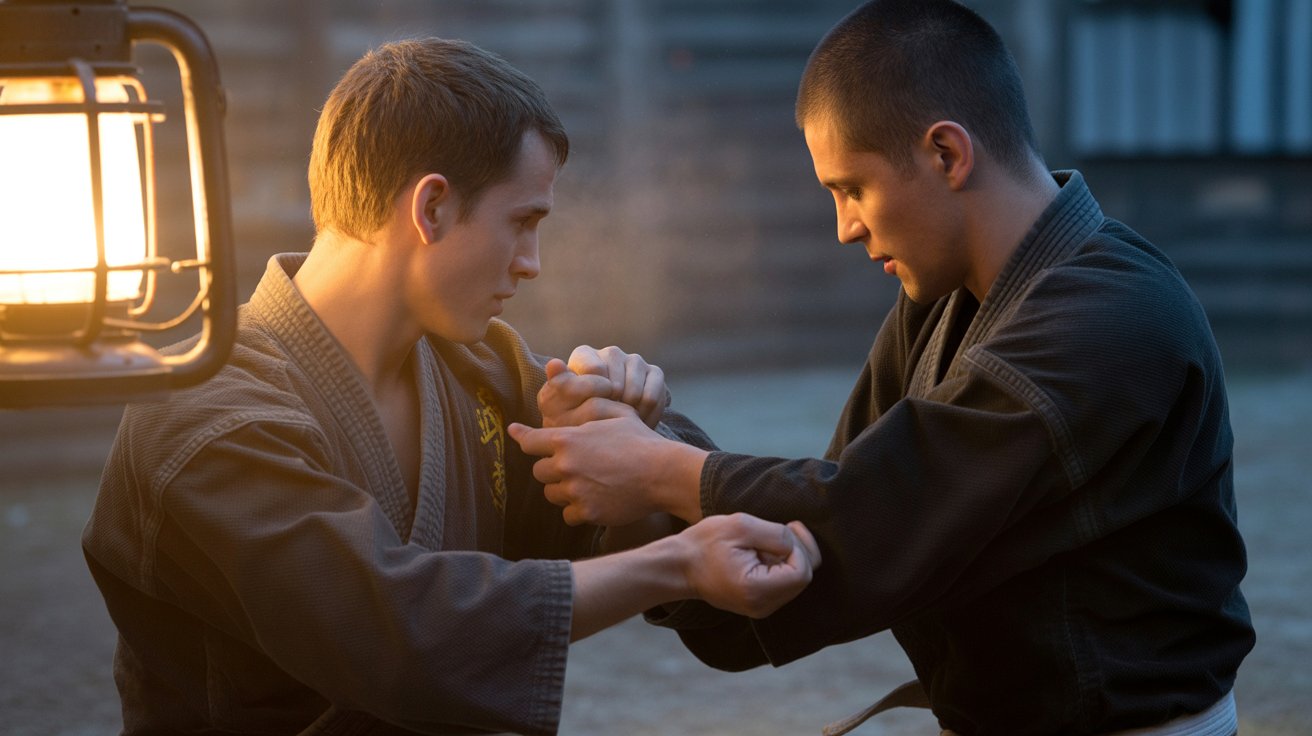
There’s a moment in every joint lock where the body realizes it has lost the argument.
Omote Gyaku lives in that moment.
It isn’t a violent twist. It isn’t a muscular wrench. When done properly, it feels almost quiet—like turning a key that was always meant to rotate that way. The compliance comes not from force, but from structure collapsing under spiral pressure.
If you’ve ever tried to perform Omote Gyaku and felt like you were wrestling instead of controlling, the issue wasn’t strength. It was alignment.
Let’s rebuild it from the ground up.
What Omote Gyaku Really Is
Omote Gyaku—often translated as “outside reverse”—is a classical rotational wrist lock found in traditional Japanese martial systems. But labels don’t explain why it works.
What makes Omote Gyaku powerful is simple:
-
It isolates the thumb line.
-
It externally rotates the wrist.
-
It combines rotation with slight extension.
-
It breaks balance before resistance can organize.
The technique exploits the wrist’s structural weakness under outward spiral torque. When the wrist rotates beyond its designed tolerance—especially while the elbow and shoulder are compromised—compliance happens quickly.
The mistake most people make? Treating it like a wrist twist instead of a body-driven rotation.
How to Perform Omote Gyaku Step by Step
We’ll use the common wrist grab scenario because it reveals every mechanical detail clearly.
Move slowly at first. Precision matters more than speed.
Step 1 – Establish Intelligent Grip Control
When someone grabs your wrist, don’t yank away.
Instead:
-
Slightly rotate your captured hand so your thumb rises upward.
-
Use your free hand to cover the back of their grabbing hand.
-
Control near the knuckles—not the fingers.
Your thumb presses across the back of their hand while your fingers secure the base of their palm. You are not squeezing. You are shaping structure.
If you feel tension in your forearms already, pause. You’re using strength instead of alignment.
Step 2 – Control the Thumb Line
Everything in Omote Gyaku depends on the thumb side of the wrist.
Guide their hand so:
-
Their thumb points upward.
-
Their wrist is slightly extended.
-
Their palm begins rotating inward toward their own centerline.
This slight pre-extension is critical. Without it, the rotation will feel weak and sloppy. With it, the lock becomes sharp and immediate.
Think of it as setting the hinge before turning the door.
Step 3 – Apply External Spiral Rotation
Now the lock begins to take shape.
Rotate their wrist outward—away from their centerline—while maintaining subtle downward pressure. Keep your elbows close. Let your hips rotate slightly to drive torque.
Do not crank.
The movement should feel like turning a key while stepping off the line of attack. Small, efficient, spiral.
If done correctly, you’ll feel their structure begin to unravel before you feel the need to push harder.
That’s leverage doing its job.
Step 4 – Break Balance Before They Resist
This is where Omote Gyaku transforms from a wrist technique into a whole-body control system.
As you continue the rotation:
-
Step diagonally forward.
-
Shift your weight subtly.
-
Guide their wrist in a circular arc.
Their shoulder should rise. Their spine should tilt. Their base should narrow.
If they can stand comfortably, you haven’t broken balance yet.
Kuzushi—off-balancing—is the invisible multiplier in this technique. Without it, you’re arm-wrestling. With it, you’re guiding a collapse.
Step 5 – Transition Into Control or Takedown
From here, the outcome depends on your intent.
Standing Compliance:
Maintain spiral pressure and walk them forward in controlled alignment.
Pin Variation:
Guide their wrist downward in a circular arc while stepping past their lead foot.
Takedown:
Increase the downward angle as their balance shifts, letting gravity assist the finish.
The key is continuity. Never let the spiral unwind.
Why Omote Gyaku Works (Even Against Larger Opponents)
Strength resists strength. Structure overrides it.
Omote Gyaku works because:
-
The wrist cannot tolerate aggressive external rotation under load.
-
The elbow follows the wrist.
-
The shoulder follows the elbow.
-
The spine follows the shoulder.
A small joint becomes a steering wheel for the entire body.
When alignment is correct, even minimal torque creates disproportionate effect.
Common Mistakes That Quietly Kill the Technique
Using Force Instead of Body Position
If your shoulders are rising and your forearms are burning, something is off.
Rotating Without Extension
The lock loses bite without slight wrist extension before rotation.
Staying Square
Standing directly in front of your partner gives them balance and resistance options. Angle off.
Forgetting Kuzushi
Balance disruption is not optional. It is foundational.
Training Omote Gyaku for Real Precision
Skill comes from refinement, not repetition alone.
Slow Structural Drills
Practice setting thumb alignment and wrist extension without finishing the lock. Build sensitivity first.
Graduated Pressure Training
Apply rotation gradually with a cooperative partner. Increase resistance slowly over time.
Angle Stepping Practice
Train diagonal stepping separately. Most balance failures occur because footwork lags behind handwork.
Speed comes later. Clean structure comes first.
Frequently Asked Questions
Is Omote Gyaku effective in real self-defense?
Yes—particularly in grip-based confrontations where control is needed without excessive striking. Its efficiency lies in how quickly it disrupts structure when applied correctly.
Does it require strength?
No. It requires proper thumb-line control, hip rotation, and balance disruption.
How is it different from Ura Gyaku?
Omote Gyaku rotates outward. Ura Gyaku rotates inward. The mechanical direction changes the stress angle and tactical application.
Can beginners safely learn this technique?
Yes, but controlled practice and responsible supervision are essential. Joint locks escalate quickly if applied recklessly.
Products / Tools / Resources
If you’re serious about developing clean Omote Gyaku mechanics, consider integrating:
-
A quality grappling dummy for solo alignment drills
-
Wrist-strengthening tools for joint stability conditioning
-
A structured traditional martial arts training program that includes live feedback
-
Slow-motion video recording to analyze your grip, angle, and body alignment
-
Protective wrist supports for extended technical drilling sessions
Technique sharpens when awareness deepens. Film your practice. Slow it down. Refine the spiral.
When Omote Gyaku stops feeling like a struggle and starts feeling inevitable—you’ll know you’re doing it correctly.