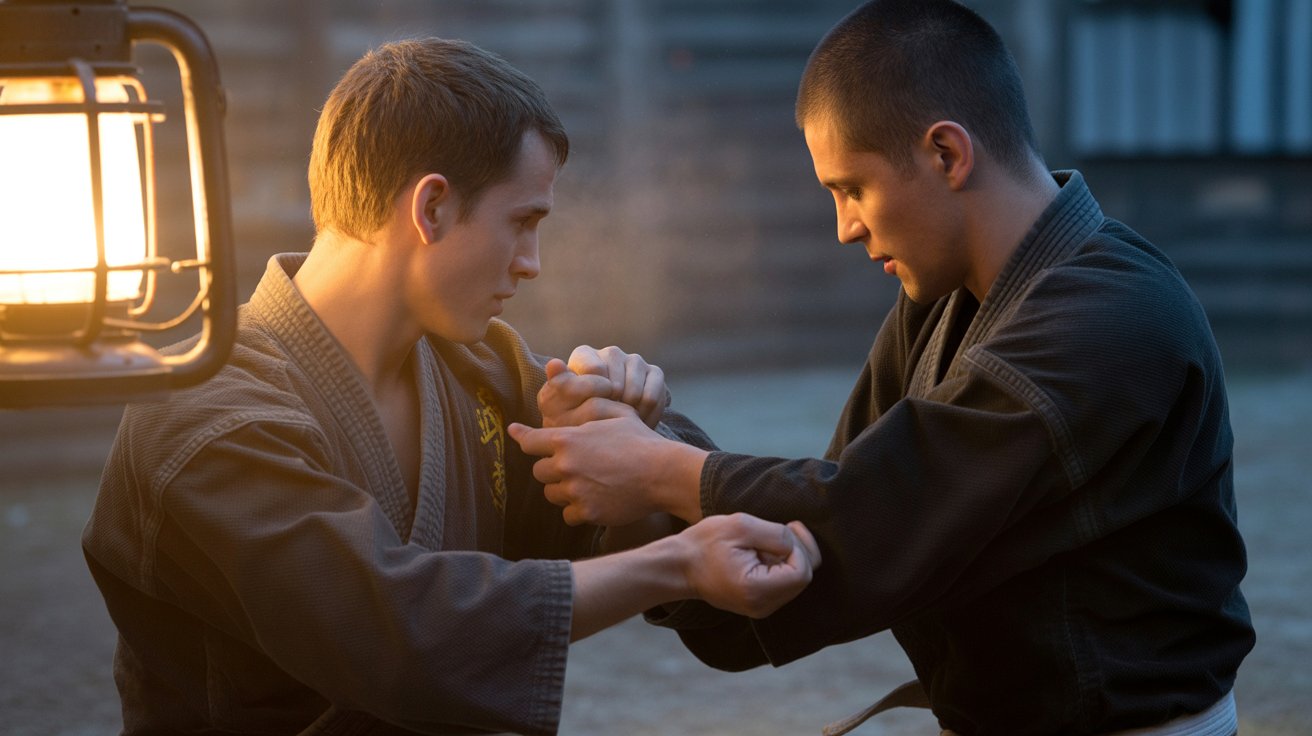
Every serious practitioner in the Bujinkan eventually discovers a quiet truth.
The advanced techniques aren’t advanced.
They’re refined basics.
At the center of that realization sits Kihon Happo — eight deceptively simple movements that shape everything else in the system. They don’t look dramatic. They aren’t designed to impress spectators. But they contain the mechanical blueprint for control, balance, leverage, and timing.
These eight methods are where real skill begins.
The Meaning Behind Kihon Happo
“Kihon” translates to foundation.
“Happo” means eight directions or eight methods.
Together, they form the structural compass of traditional schools like Gyokko-ryu and Koto-ryu.
They are not techniques you “get past.”
They are techniques you grow into.
Over time, you begin to notice that nearly every advanced kata echoes one of these eight core ideas.
The First Layer: Posture as Power
Before locks.
Before throws.
Before control.
There is posture.
The three foundational forms — Ichimonji no Kamae, Hicho no Kamae, and Jumonji no Kamae — train something subtle but transformative: structural intelligence.
Done correctly, they teach:
-
How to align your spine without stiffness
-
How to distribute weight without telegraphing
-
How to protect your centerline without tension
They are not static shapes. They are living frameworks.
The Five Core Techniques of Control
Then come the five capturing methods — the heart of applied movement.
Omote Gyaku spirals outward, stretching the wrist along its weakest line.
Ura Gyaku folds inward, compressing structure with surgical precision.
Musha Dori elevates and rotates the arm until posture collapses.
Ganseki Nage redirects energy and uproots balance through timing.
Oni Kudaki compresses the shoulder line, folding structure downward.
On paper, they look like joint locks and throws.
In practice, they are lessons in leverage, angles, and patience.
The Invisible Skill: Kuzushi
What beginners often miss is that the lock isn’t the technique.
The off-balance is.
Kuzushi — the art of breaking balance — happens a split second before visible movement. A slight angle. A subtle pull. A hesitation created in the opponent’s body.
When kuzushi is correct, the technique feels effortless.
When it’s missing, everything feels forced.
Movement Before Muscle
One of the most common mistakes in Kihon Happo training is squeezing harder when something fails.
But the system doesn’t reward strength. It rewards alignment.
The wrist connects to the elbow.
The elbow connects to the shoulder.
The shoulder connects to the spine.
The spine connects to the hips.
When that chain is aligned, leverage multiplies. When it’s broken, technique dissolves.
This is why smaller practitioners can control larger ones — not through force, but through geometry.
From Dojo Form to Real-World Pressure
The question inevitably arises: does it work?
It can — if trained beyond choreography.
Real conflict doesn’t pause for perfect entries. Distance collapses. Timing accelerates. Adrenaline distorts fine motor control.
Kihon Happo prepares you not by giving you scripted answers, but by teaching:
-
How to move off-line instinctively
-
How to control space
-
How to redirect force instead of absorbing it
The techniques are templates. Adaptation is the real skill.
Where Progress Stalls
Plateaus in training often come from subtle errors:
Rushing the entry.
Forcing the finish.
Ignoring footwork.
Chasing the lock instead of the balance.
True progress feels slower at first. You begin to notice tiny adjustments — hip rotation, shoulder relaxation, the angle of your step. Those micro-corrections compound over years.
And that’s where mastery hides.
Why Kihon Happo Never Stops Being Relevant
Advanced kata do not replace fundamentals.
They refine them.
Every time you return to Kihon Happo, you notice something new — a cleaner entry, a smoother off-balance, a more effortless transition.
Eventually, the eight techniques stop feeling like separate moves.
They become one continuous language of motion.
Products / Tools / Resources
-
A high-quality training gi with reinforced sleeves (wrist-lock training stresses fabric)
-
A heavy-duty focus mitt for striking alignment practice
-
Resistance bands for strengthening wrist stability
-
A grappling dummy for solo entry drills
-
A training journal to track refinements in footwork and kuzushi
- bujinkan kihon happo techniques explained