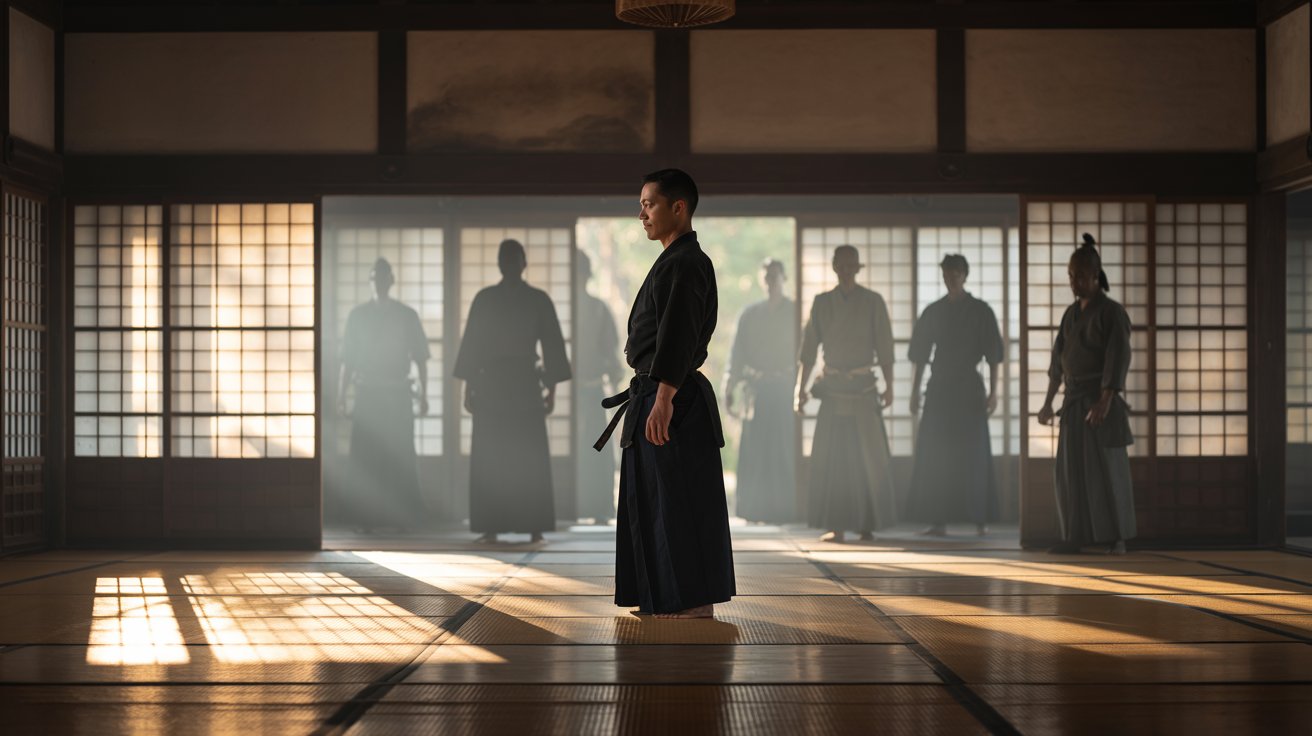
There are martial arts you practice for medals.
And then there are martial arts you inherit.
Bujinkan Budo Taijutsu belongs to the second category.
It is not built for arenas or point systems. It was shaped by battlefields, survival, and centuries of transmission. At its center is a single question: How does a human being move in harmony with danger instead of resisting it?
Founded by Masaaki Hatsumi, the Bujinkan preserves nine classical Japanese martial traditions passed down from his teacher, Toshitsugu Takamatsu. Together, these nine schools form a complete martial ecosystem — one that blends samurai battlefield arts with ninjutsu survival systems.
To understand Bujinkan, you have to look deeper than techniques.
What Does “Bujinkan Budo Taijutsu” Actually Mean?
-
Bujinkan – “Hall of the Divine Warrior”
-
Budo – The martial way; a path of character refinement through combat study
-
Taijutsu – Body skill; natural, efficient human movement
This is not a style defined by rigid forms. It is a way of moving — intelligently, subtly, without wasted force.
Where many martial arts condition you to clash, Bujinkan teaches you to dissolve conflict before it solidifies.
The Nine Ryuha of the Bujinkan
At the heart of Bujinkan are nine historical schools (ryuha). Each one carries a distinct tactical personality. Together, they create depth that few systems can rival.
1. Togakure-ryu Ninpō Taijutsu
Perhaps the most recognized lineage, Togakure-ryu represents classical ninjutsu. It emphasizes evasion, unconventional tactics, distance manipulation, and strategic withdrawal. Movement is fluid and elusive — survival over domination.
2. Gyokko-ryu Kosshijutsu
Known for attacking muscle and nerve points, Gyokko-ryu emphasizes precision striking and angular body positioning. It teaches practitioners to control structure through subtle alignment rather than brute force.
3. Koto-ryu Koppojutsu
Sharp, direct, and bone-focused. Koto-ryu specializes in structural destruction — targeting skeletal weaknesses and breaking posture quickly. Its movement feels compact and decisive.
4. Shinden Fudo-ryu Dakentaijutsu
Rooted in natural posture and environmental awareness, Shinden Fudo-ryu rejects artificial stances. It trains spontaneous movement, grounded power, and adaptability in unpredictable terrain.
5. Kukishinden-ryu Happo Bikenjutsu
A battlefield art with extensive weapon integration. Staff, spear, sword — Kukishinden-ryu embodies armored combat principles and powerful linear techniques suited for warfare.
6. Takagi Yoshin-ryu Jutaijutsu
Close-quarter grappling designed for confined environments. It focuses on throws, joint locks, and controlling opponents when space is limited — historically useful inside buildings or narrow pathways.
7. Gikan-ryu Koppojutsu
A rarer school emphasizing powerful, grounded strikes and distinctive angling. Its teachings are subtle and less frequently demonstrated publicly.
8. Gyokushin-ryu Ninpō
A ninjutsu lineage specializing in strategy, deception, and battlefield intelligence. Historically associated with espionage and subtle tactical movement.
9. Kumogakure-ryu Ninpō
Another ninjutsu tradition, known for evasive body mechanics and unique weapon adaptations. Its methods reflect mobility and unconventional engagement.
These nine traditions are not practiced as isolated systems. Instead, they function as lenses — each revealing a different dimension of movement, distance, and intent.
This layered structure is what makes Bujinkan feel deep rather than repetitive.
How Bujinkan Training Actually Feels
Walk into a Bujinkan dojo and you may notice something unusual.
There is no aggressive shouting.
No tension-filled face-offs.
No obsession with winning rounds.
Instead, you’ll see:
-
Fluid partner drills
-
Rolling and breakfalls (ukemi)
-
Subtle off-balancing
-
Circular evasions
-
Weapons integrated naturally into movement
The foundation is Kihon Happo — eight core principles that teach joint locks, balance disruption, and striking alignment. These fundamentals are revisited constantly. Not for repetition’s sake — but for refinement.
Ukemi training develops survival mobility. You don’t just fall. You flow.
Weapons such as the bo, hanbo, katana, and tanto are introduced not as separate arts, but as extensions of body mechanics. Distance awareness deepens. Timing sharpens.
Over time, the body stops reacting with stiffness and begins responding with adaptability.
Is Bujinkan the Same as Ninjutsu?
Not exactly — though it includes ninjutsu traditions.
Three of the nine schools (Togakure-ryu, Gyokushin-ryu, Kumogakure-ryu) stem from ninpō lineages. The others derive from samurai battlefield systems.
Ninjutsu within Bujinkan emphasizes:
-
Strategy over ego
-
Evasion over collision
-
Awareness over aggression
But the art as a whole is broader — blending grappling, striking, weapon systems, and battlefield principles into a unified framework.
Does Bujinkan Work for Self-Defense?
This question often arises from a modern lens shaped by sport fighting.
Bujinkan was never designed for tournaments. It was shaped for unpredictability.
Its strengths include:
-
Structural manipulation instead of strength contests
-
Off-balancing and joint control
-
Environmental awareness
-
Weapon consciousness
-
Psychological composure
Its effectiveness depends heavily on instructor quality and training depth. In strong dojos, practitioners develop calm under pressure and the ability to move without telegraphing intention.
It is less about overpowering an attacker — and more about dismantling structure before resistance escalates.
Who Is Bujinkan For?
Bujinkan tends to attract:
-
Martial artists seeking historical continuity
-
Individuals fascinated by samurai and shinobi traditions
-
Practitioners who prefer refinement over competition
-
Those interested in classical Japanese weapon systems
It is not ideal for someone whose primary goal is cage fighting dominance.
It is ideal for someone who values long-term study, subtlety, and layered understanding.
Finding an Authentic Bujinkan Dojo
Authenticity matters in lineage arts.
Look for schools connected to Bujinkan Honbu Dojo, the headquarters in Noda, Japan.
Observe a class before committing.
Pay attention to movement quality, not theatrics.
Ask about instructor rank and training history.
In traditional arts, lineage is living currency.
Questions Students Often Ask
Is Bujinkan beginner-friendly?
Yes. Many dojos accept complete beginners and emphasize gradual progression through foundational movement.
How long does it take to earn a black belt?
Unlike modern systems with strict timelines, progression in Bujinkan varies widely. Rank reflects internalization — not simply attendance.
Do practitioners spar?
Some instructors incorporate resistance-based drills, but structured sport sparring is not the system’s core.
Is it physically intense?
Training can be demanding, but it prioritizes efficiency over brute force, making it sustainable across age groups.
Products / Tools / Resources
If you’re exploring Bujinkan Budo Taijutsu, these resources can deepen your understanding:
-
Books by Masaaki Hatsumi – Particularly “The Essence of Ninjutsu” and “Advanced Stick Fighting.”
-
Traditional Budo Taijutsu training gi (heavy cotton recommended for grappling durability)
-
A quality rokushakubo (6-foot staff) for foundational weapons practice
-
Access to seminar listings through official Bujinkan networks
-
Dojo directories affiliated with Bujinkan Honbu
Serious study begins with curiosity — but it matures through consistent practice under qualified instruction.
And that, ultimately, is what Bujinkan Budo Taijutsu is:
Not a performance.
Not a trend.
But a living transmission of movement, strategy, and awareness passed from one generation to the next.