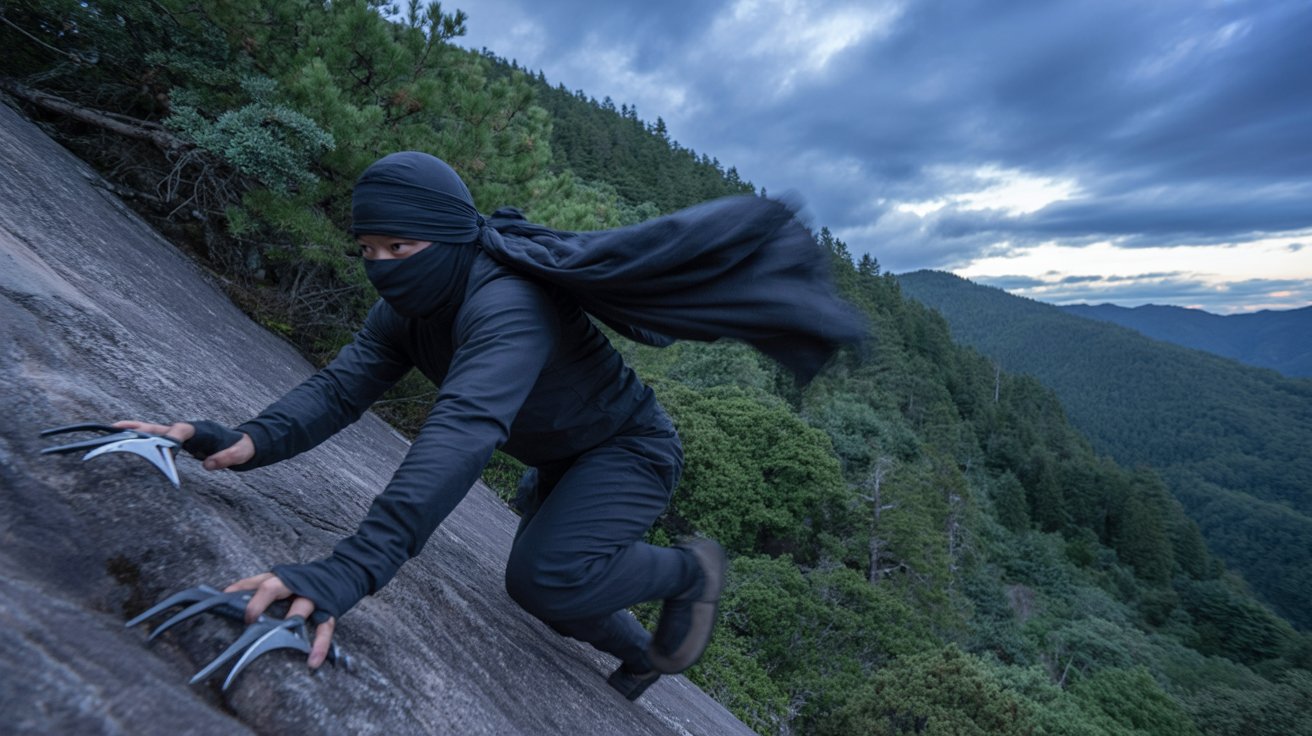
There’s a quiet difference between mythology and memory.
Myth dazzles. Memory endures.
When people hear the word ninja, they often picture smoke bombs and rooftop silhouettes. But the real story of Kumogakure-ryū Ninpō history and lineage does not begin in fantasy. It begins in the mountains of Iga—where survival wasn’t theatrical, it was tactical.
To trace this lineage is not to chase legend. It is to follow a current that runs beneath centuries of political upheaval, secrecy, preservation, and disciplined transmission.
And like clouds drifting across a mountain ridge, much of it was never meant to be easily seen.
The Iga Crucible: Where Strategy Replaced Spectacle
A Country at War
Feudal Japan was fractured. The Sengoku period reshaped power structures almost yearly. Alliances collapsed. Castles burned. Armies moved like tides.
In that chaos, conventional warfare wasn’t always enough.
The Iga region—rugged, forested, defensive by geography—cultivated something different. Independent warrior families developed systems built not on open battlefield glory, but on intelligence, misdirection, and precision.
Shinobi were not supernatural assassins. They were strategic specialists.
And within that environment, traditions like Kumogakure-ryū took form.
Why Ninpō Emerged
Samurai culture prized visibility—armor, banners, honor in plain sight.
But war rewards adaptability more than visibility.
Ninpō, often used interchangeably with ninjutsu yet carrying deeper philosophical undertones, formalized principles of:
-
Disappearance
-
Terrain mastery
-
Psychological manipulation
-
Escape over domination
-
Survival over spectacle
Kumogakure-ryū did not evolve to overpower. It evolved to outlast.
Identity Rooted in Terrain
Iga warriors were shaped by mountains. Steep inclines, dense forests, hidden pathways. Their techniques mirrored the land itself.
Kumogakure—“Hidden in the Clouds”—was not poetic branding. It was strategic doctrine.
Clouds obscure without effort. They move without attachment. They reveal nothing.
That mindset became identity.
The Emergence of Kumogakure-ryū
Between Scroll and Silence
The challenge in studying Kumogakure-ryū Ninpō history and lineage is intentional obscurity.
Unlike battlefield schools that recorded victories in detail, shinobi traditions protected knowledge through:
-
Oral transmission
-
Guarded densho scrolls
-
Restricted lineage inheritance
Documentation gaps are not proof of absence. They are evidence of operational discretion.
Certain accounts associate Kumogakure-ryū with mountain specialists who developed advanced climbing methods and lightweight armor adaptations. While scholars debate specifics, the tactical themes remain consistent.
Concealment. Mobility. Evasion.
Warfare on Vertical Ground
Mountain combat rewrites the rules.
Heavy armor becomes liability. Linear formations fail. Escape routes multiply.
Kumogakure-ryū techniques emphasized:
-
Agile movement on uneven terrain
-
Hooked or adaptable tools for climbing and engagement
-
Armor variations designed for speed rather than direct impact
-
Tactical withdrawal as strategic victory
To disappear was not retreat. It was control.
The Power of the “Cloud-Hidden” Symbol
The symbolism carries weight even now.
Clouds:
-
Conceal shape
-
Distort distance
-
Shift constantly
-
Resist capture
The psychological dimension of ninpō is embedded here. The enemy unsettled by uncertainty is already destabilized.
Kumogakure-ryū encoded ambiguity into its name.
Lineage: The Invisible Thread
Transmission Beyond Bloodline
In traditional Japanese martial arts, lineage is not nostalgia—it is structural integrity.
The sōke model ensures continuity of principles across generations. But with ninja traditions, preservation became complicated. Political suppression, modernization, and social transformation fractured many lines of transmission.
Kumogakure-ryū survived not through public record, but through custodianship.
Lineage is less about celebrity founders and more about uninterrupted instruction.
Integration into Broader Ninpō Systems
In the 20th century, efforts were made to consolidate and preserve classical schools that might otherwise disappear. Within structured ninpō organizations, Kumogakure-ryū teachings were incorporated into comprehensive curricula.
This ensured survival—but also created scrutiny.
When traditions merge, questions arise:
-
What remains original?
-
What has evolved?
-
Where does documentation meet interpretation?
These are not signs of weakness. They are signs of living history.
The Reality of Historical Gaps
Scholars examining Kumogakure-ryū Ninpō history and lineage often encounter incomplete records.
Wars destroy archives. Secrecy limits publication. Oral transmission resists documentation.
But martial tradition has always balanced written and embodied knowledge.
Some truths live in scrolls. Others live in movement.
What Makes Kumogakure-ryū Distinct?
Equipment Built for Adaptation
Unlike heavily armored battlefield systems, Kumogakure-ryū descriptions include lighter configurations—functional, flexible, optimized for terrain fluidity.
Tools doubled in purpose. Farming implements could become weapons. Everyday objects transformed under trained hands.
Nothing wasted. Nothing ornamental.
The Strategy of Disengagement
Here lies one of the most misunderstood aspects of ninpō.
Victory is not always domination.
Sometimes victory is:
-
Mission completed without exposure
-
Escape executed without pursuit
-
Influence exerted without detection
Disappearance is a skill. So is restraint.
Psychological Pressure Without Presence
A force that cannot be located becomes a mental burden.
Shinobi tactics often manipulated perception:
-
Sounds without visible source
-
Traces that misdirect
-
Strategic absence
Psychological warfare was subtle, sustainable, and deeply unsettling.
Why Lineage Still Matters Today
The Commercialization Problem
Modern culture romanticizes ninja imagery. The term itself has been commodified globally.
This makes lineage verification essential.
Authenticity in classical martial arts rests on:
-
Documented transmission
-
Recognized organizational continuity
-
Transparent instructor history
Without lineage, “tradition” becomes branding.
Evaluating Modern Claims
If you’re researching Kumogakure-ryū Ninpō history and lineage today, ask:
-
Who transmitted this system?
-
Through which recognized framework?
-
Is historical ambiguity acknowledged honestly?
Serious traditions welcome scrutiny.
Preservation in the Digital Era
Ironically, the internet—once viewed as threat to tradition—now preserves it.
Digital archives, translated scrolls, global communication between practitioners—these tools protect what earlier generations guarded by necessity.
Yet the responsibility remains human.
Transmission is not uploading files. It is living instruction.
Kumogakure-ryū in the Modern Dojo
Walk into a modern training hall and you will not find medieval espionage missions.
You will find repetition.
Body mechanics refined through taijutsu.
Weapons handled with discipline, not theatrics.
Historical context studied with respect.
The practitioner today trains not to infiltrate castles—but to internalize strategy, movement efficiency, and cultural continuity.
The battlefield has changed.
The principles have not.
Adapt. Conceal. Endure.
Frequently Asked Questions
Is Kumogakure-ryū historically documented in detail?
Not exhaustively. Like many ninjutsu traditions, its documentation is partial and preserved within classical transmission systems rather than public archives.
How is Kumogakure-ryū different from other ninja schools?
Each ryūha carries distinct tactical emphasis. Kumogakure-ryū is often associated with mobility, mountain adaptability, and strategic disappearance.
Can someone train in Kumogakure-ryū today?
Yes—typically within structured ninpō organizations that preserve classical curriculum under recognized lineage frameworks.
Why are there debates about ninja history?
Operational secrecy, destroyed records, and oral transmission contribute to historical ambiguity. Debate reflects analysis, not dismissal.
Products / Tools / Resources
If you’re serious about exploring Kumogakure-ryū Ninpō history and lineage, depth matters more than aesthetics. Consider:
-
Classical ninpō texts and translated densho compilations from recognized instructors
-
Enrollment in established ninpō organizations with documented lineage transparency
-
Seminars led by senior practitioners within authenticated transmission lines
-
Historical studies on Iga and Sengoku-period warfare for contextual grounding
-
Personal training journals to track technical evolution over time
Tradition is not consumed. It is practiced.
And like clouds over the mountains of Iga, its shape reveals itself only to those patient enough to watch.