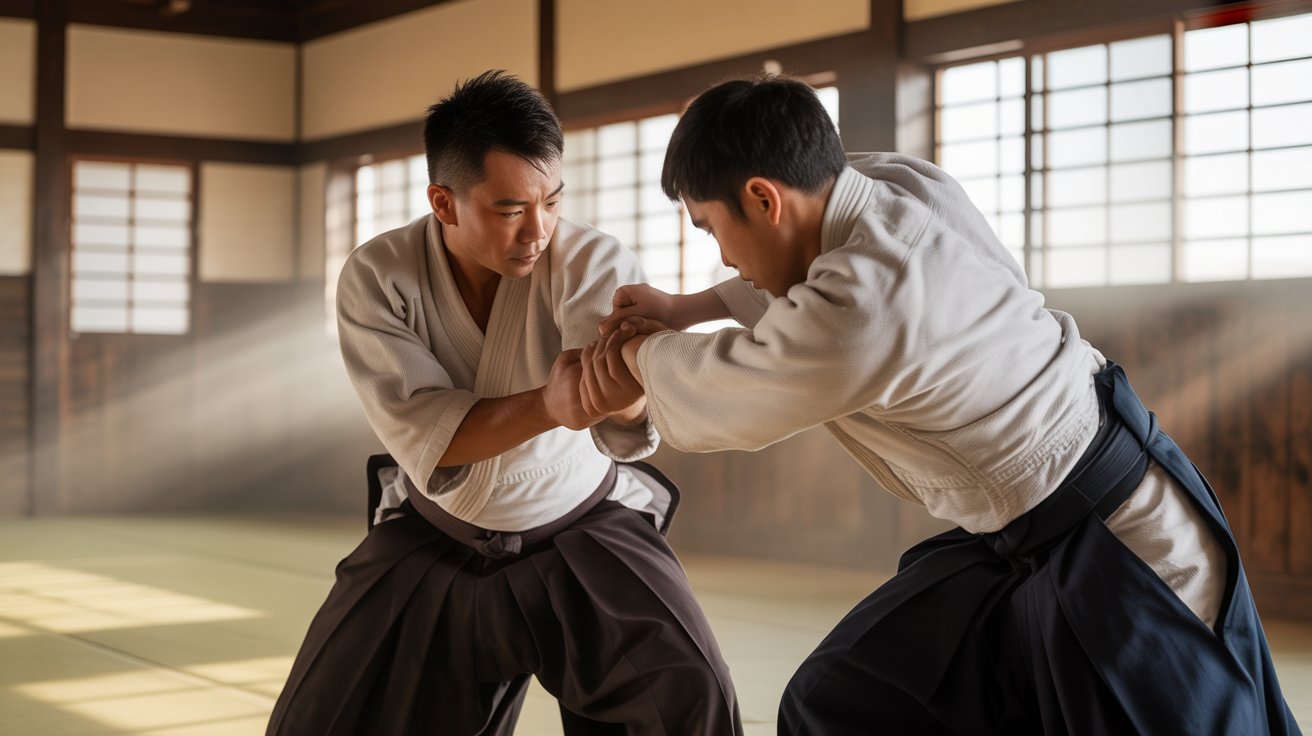
There’s something different about stepping into a dojo that teaches Takagi Yoshin-ryu.
It doesn’t feel like a sport gym. It doesn’t feel commercial. The movements are quieter. The structure is older. The techniques carry a weight that suggests they were not invented for medals—but for survival.
Understanding the lineage and history of Takagi Yoshin-ryu Jūtaijutsu is not about memorizing dates. It’s about tracing a living transmission that has survived political upheaval, modernization, war, and globalization without losing its structural identity. This is a classical system—one shaped by battlefield logic and preserved through disciplined succession.
And lineage, here, is everything.
What Takagi Yoshin-ryu Actually Is
Takagi Yoshin-ryu is a koryu—a classical Japanese martial tradition established before the Meiji Restoration of 1868. That distinction matters.
Koryu arts were not built for tournaments. They were engineered for conflict.
At its core, Takagi Yoshin-ryu specializes in jūtaijutsu, a system of close-quarters grappling that emphasizes:
-
Joint locks and structural breaks
-
Throws designed for armored opponents
-
Body control and positional dominance
-
Immobilizations that neutralize without wasted movement
The techniques are compact. Efficient. Direct.
Unlike modern grappling arts shaped by mats and weight classes, this system evolved for narrow hallways, uneven terrain, and armored bodies. Every movement assumes the presence of danger.
That context defines the art.
Koryu vs. Modern Martial Arts
To understand Takagi Yoshin-ryu lineage, you must understand the difference between koryu and gendai budo.
Gendai systems—like modern judo or sport jujutsu—emerged after Japan industrialized. They often use ranking systems, standardized curricula, and competitive frameworks.
Takagi Yoshin-ryu predates that entire structure.
Progression was never about belts. It revolved around densho (transmission scrolls), oral teachings, and licensing systems such as menkyo and menkyo kaiden. Advancement required trust, demonstrated understanding, and personal transmission from teacher to student.
Lineage was not symbolic. It was functional.
The Founder: Takagi Oriemon Shigenobu
The system traces back to the 17th century and the samurai Takagi Oriemon Shigenobu.
Historical documentation from feudal Japan is rarely pristine, but Takagi is consistently recognized as the formalizing force behind the ryu. He refined a body of techniques that emphasized adaptability—responding to force without resisting it head-on.
The name “Yoshin” is often interpreted as “raised heart” or symbolically linked to flexibility, like a willow tree bending in a storm. The metaphor fits the art.
Rather than clashing, it redirects.
Rather than overpowering, it destabilizes.
This principle became the philosophical backbone of the system.
How the System Was Transmitted
During the Edo period (1603–1868), Takagi Yoshin-ryu passed through designated heads of the school—known as sōke.
Transmission was direct. Personal. Controlled.
Students did not simply enroll. They were accepted. Over time, deeper layers of curriculum were revealed—often accompanied by scrolls documenting kata, principles, and strategic doctrine.
Much of the system was also preserved through kuden, oral teachings that clarified nuance beyond written form. In koryu traditions, the scroll gives structure—but the teacher gives life.
This is why lineage chains matter so deeply. The art survives through continuity, not replication.
Takamatsu Toshitsugu and 20th Century Preservation
The 19th and early 20th centuries were turbulent for classical martial arts.
The Meiji Restoration dissolved the samurai class. Western influence flooded Japan. Many traditional schools disappeared.
Takagi Yoshin-ryu survived in part because of figures like Takamatsu Toshitsugu, a pivotal martial artist who inherited and transmitted multiple classical systems. His dedication ensured that Takagi Yoshin-ryu did not fade into obscurity during a time when many koryu were quietly extinguished.
Takamatsu’s role is often viewed as a preservation bridge—connecting feudal-era transmission to modern practitioners.
Without that link, the art might exist today only as a historical footnote.
Masaaki Hatsumi and Global Exposure
One of Takamatsu’s most recognized students, Masaaki Hatsumi, carried forward several classical traditions and introduced them to an international audience.
Through organizational structures and global seminars, Takagi Yoshin-ryu principles reached practitioners far beyond Japan.
This exposure changed the landscape.
For the first time, a deeply traditional system entered a modern, globalized martial arts environment.
With expansion came both opportunity and complexity.
Independent Lines and Organizational Transmission
Today, Takagi Yoshin-ryu exists within:
-
Organizations connected to Takamatsu’s transmission
-
Independent Japanese lines
-
International dojos with documented lineage ties
This has naturally sparked conversations about authenticity.
In classical arts, legitimacy is determined by:
-
Documented teacher-student succession
-
Recognized licensing stages
-
Verifiable connection to established Japanese authorities
Marketing does not define authenticity. Documentation and transmission do.
For serious practitioners researching Takagi Yoshin-ryu lineage and history, this distinction is essential.
Surviving the Meiji Restoration
When the Meiji government dismantled the samurai class, many martial systems lost purpose overnight.
Without battlefield relevance, countless schools disappeared.
Takagi Yoshin-ryu endured because it remained within closed transmission circles. It adapted from military application to personal development while preserving its structural DNA.
It did not reinvent itself.
It refined itself.
That subtle difference ensured survival without dilution.
Post–World War II Revival
After World War II, Japan experienced another cultural reset. Martial arts faced restrictions before eventually resurging.
Interest in traditional budo grew internationally during the mid-20th century. Practitioners sought authenticity—something older than competition.
Takagi Yoshin-ryu, with its intact lineage structure, offered that depth.
Seminars, cross-cultural exchange, and documentation allowed the art to expand globally without completely severing its roots.
Why Lineage Still Matters Today
In modern martial arts culture, it’s easy to dismiss lineage as ceremonial.
In Takagi Yoshin-ryu, lineage protects the architecture of the art.
It safeguards:
-
Technical precision
-
Strategic context
-
Philosophical continuity
-
Historical integrity
Without lineage, techniques become fragments. With lineage, they remain part of a coherent combat system refined over centuries.
When someone searches for “Takagi Yoshin ryu lineage and history,” what they are often really asking is:
Is this art real?
Is it intact?
Is it authentic?
The answer lies in transmission.
Frequently Asked Questions
Is Takagi Yoshin-ryu the same as modern jujutsu?
No. It predates modern sport-based systems and was designed for armored, battlefield-oriented environments. Its context and structure are fundamentally different.
How old is Takagi Yoshin-ryu?
Its origins trace back to the 17th century, firmly placing it among Japan’s classical martial traditions.
How do I verify authentic lineage?
Look for documented succession lines, recognized licensing structures, and clear teacher-student transmission. In koryu systems, lineage should be traceable—not implied.
Products / Tools / Resources
If you are researching or training in Takagi Yoshin-ryu, consider these resources:
-
Documented Dojo Directories connected to recognized lineage holders
-
Classical martial arts books covering koryu history and densho traditions
-
Seminars taught by instructors with traceable transmission
-
Japanese language resources for deeper historical context
-
Training journals to track kata progression and technical refinement
Serious study begins with serious research. In classical arts, patience and verification are part of the path.