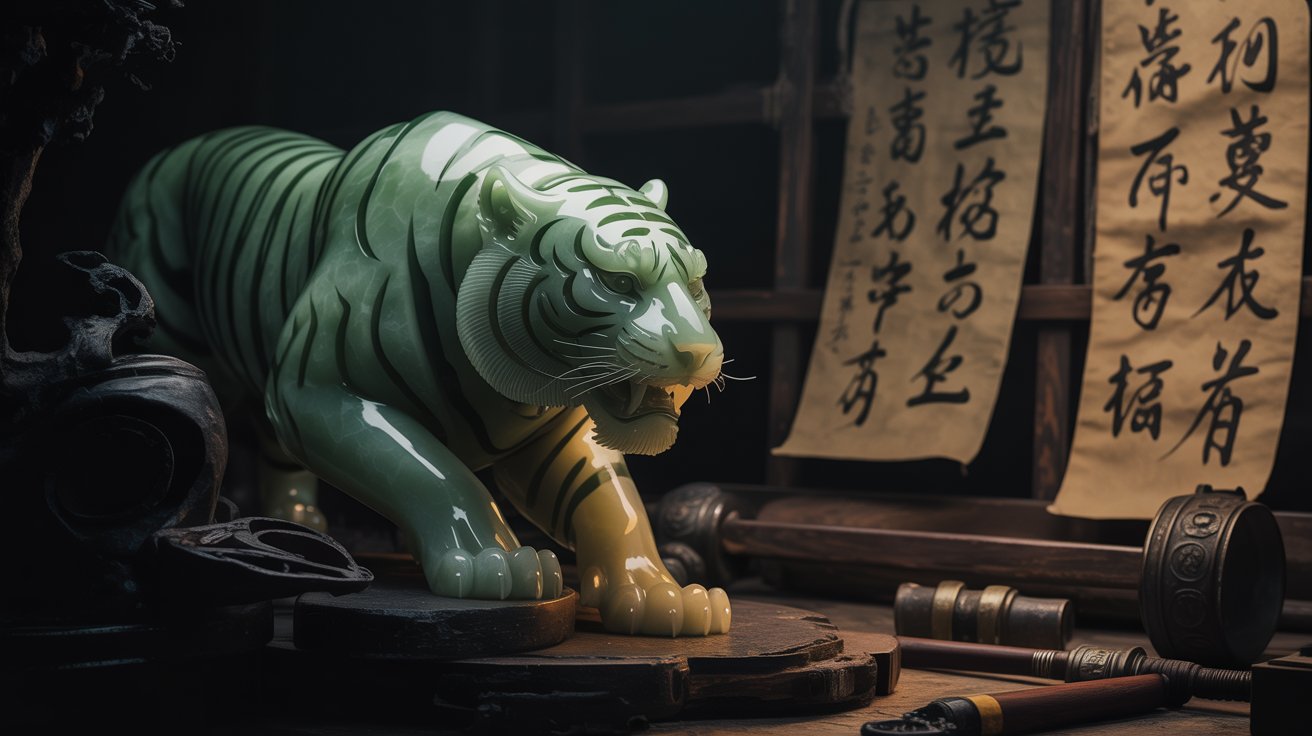
Gyokko Ryū Koshijutsu doesn’t arrive with noise or spectacle. It doesn’t need dramatic legends or exaggerated claims to justify its existence. Its authority comes from something quieter and far more enduring: movement that works, distance that controls, and principles that survive long after techniques fade.
Its history isn’t written in neat timelines. It lives in fragments—passed hand to hand, body to body—preserved by those who understood that some knowledge loses its power the moment it’s overexplained.
To study Gyokko Ryū is to accept that not all truths are meant to be obvious.
Understanding Gyokko Ryū Koshijutsu
Gyokko Ryū is often translated as the “Jade Tiger School,” a name that hints at refinement rather than brute force. The term koshijutsu refers to a method of combat that targets muscles, soft tissue, balance, and structural weakness instead of relying on bone-breaking power.
Where harder systems collide, Gyokko Ryū slips.
Its techniques emphasize:
-
Striking muscle groups to disrupt movement
-
Attacking posture and balance rather than strength
-
Creating openings through angling and footwork
-
Controlling distance so the opponent never feels stable
Rather than overwhelming an adversary, Gyokko Ryū dismantles them—quietly, efficiently, and often before they understand what’s happening.
Echoes of the Continent: Chinese Martial Influence
Traditional lineage accounts trace Gyokko Ryū’s conceptual roots beyond Japan, pointing toward ancient Chinese martial theory. While exact documentation is scarce, the technical fingerprint is unmistakable.
Classical Chinese systems emphasized:
-
Softness overcoming hardness
-
Targeting muscles, tendons, and nerves
-
Circular movement and off-line entry
These ideas align seamlessly with Gyokko Ryū’s approach. The art doesn’t fight force head-on. It bends around it, entering at angles that collapse structure and intent.
Martial knowledge traveled across borders during periods of trade, diplomacy, and migration. Techniques weren’t imported whole—they were absorbed, refined, and reshaped. By the time Gyokko Ryū took form in Japan, its principles had already been adapted to a new cultural and tactical environment.
Gyokko Ryū in Feudal Japan
Once established in Japan, Gyokko Ryū evolved in response to the realities of feudal conflict. Armor, terrain, and social hierarchy all demanded efficiency. Flashy techniques were liabilities. Survival favored precision.
Gyokko Ryū distinguished itself through:
-
Emphasis on evasive movement
-
Angled footwork that avoided direct impact
-
Strikes designed to compromise mobility instantly
These qualities made it especially valuable in unpredictable encounters—whether on the battlefield, in confined spaces, or during sudden confrontations where strength and size offered no guarantee of success.
Rather than dominating through force, Gyokko Ryū specialized in taking away options.
The Misunderstood Connection to Ninjutsu
Gyokko Ryū is frequently labeled as a “ninjutsu art,” but this oversimplification misses its true role. Gyokko Ryū is not ninjutsu. It is one of the foundational combat systems that informed the taijutsu used within ninjutsu traditions.
Its influence appears in:
-
Footwork patterns emphasizing distance and timing
-
Body angling that avoids direct clashes
-
Tactical thinking centered on survival over honor
Ninjutsu required adaptable body mechanics—skills that worked in armor, in darkness, and under pressure. Gyokko Ryū provided those mechanics. It was a framework, not a disguise.
This adaptability explains why Gyokko Ryū endured while many rigid systems disappeared.
Secrecy, Transmission, and the Absence of Records
Modern readers often search for definitive dates, founders, and documents. Classical ryūha operated under different assumptions. Knowledge was never meant for mass distribution.
Scrolls (densho) existed, but they were reminders, not explanations. Real transmission occurred through:
-
Direct instruction
-
Physical correction
-
Repeated embodied practice
Ambiguity was intentional. It protected the art and ensured that only those who committed to training gained access to its deeper layers. Gyokko Ryū’s fragmented history is not a flaw—it’s evidence that it functioned exactly as intended.
Takamatsu Toshitsugu and Survival into the Modern Era
Gyokko Ryū’s continuation into the twentieth century is inseparable from Takamatsu Toshitsugu. A martial artist shaped by real conflict, Takamatsu embodied the principle-driven mindset of classical systems.
He did not preserve Gyokko Ryū as a museum piece. He preserved it as a living method.
His teachings emphasized:
-
Adaptability over rigid form
-
Feeling over appearance
-
Principle over memorization
Through his transmission to Masaaki Hatsumi, Gyokko Ryū entered modern practice without losing its internal logic. The art survived not because it was softened, but because it was understood correctly.
Gyokko Ryū in Modern Taijutsu Practice
Today, Gyokko Ryū is studied primarily through taijutsu-based systems, most notably within the Bujinkan. Its kata are not treated as fixed routines, but as laboratories for movement.
Training focuses on:
-
Kamae that teach intent and structure
-
Footwork that controls distance invisibly
-
Body alignment that disrupts opponents effortlessly
Gyokko Ryū remains foundational because it teaches how to move intelligently, not how to collect techniques. Its lessons deepen with time rather than becoming obsolete.
Why Gyokko Ryū Endures
Gyokko Ryū Koshijutsu survives because it addresses a universal reality: conflict is unpredictable, and strength is unreliable. The art offers a way to navigate danger through awareness, positioning, and timing.
Its history lives on not in archives, but in motion.
Those who practice it correctly don’t just learn techniques—they inherit a way of seeing space, bodies, and intent.
Products / Tools / Resources
-
Classical Japanese martial arts history books and ryūha references
-
Taijutsu training manuals focused on movement principles
-
Seminars and workshops teaching Takamatsuden lineages
-
Translated densho and lineage charts for contextual study
-
Minimalist training equipment for balance, posture, and footwork development
- Beginner to Black Belt Ninjutsu Course