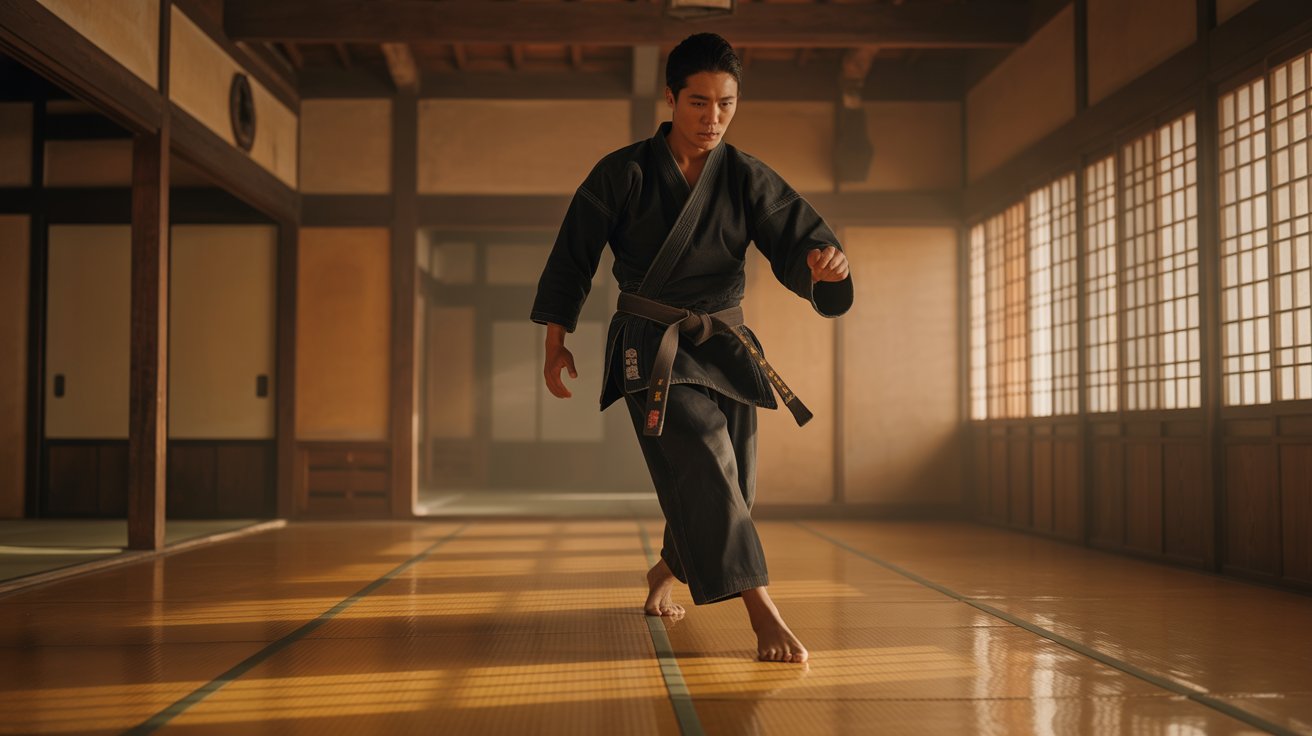
People often describe the Bujinkan as a martial arts organization. That description isn’t wrong—but it’s incomplete. What the Bujinkan actually preserves is something far older and far more subtle: nine classical Japanese martial traditions, transmitted as living knowledge rather than frozen techniques.
If you’ve ever heard practitioners mention “the nine traditions” and felt unsure what that really means, you’re not alone. Are they nine separate martial arts? Nine historical styles? Nine names for the same thing?
The truth sits somewhere deeper. Understanding the nine traditions isn’t just about history—it reshapes how you move, how you train, and how you understand conflict itself.
What the Nine Traditions Really Are
In Japanese martial culture, a ryu (or ryuha) is not a brand or a syllabus. It is a complete worldview of combat, shaped by the era it came from and the problems it was designed to solve.
Each ryuha carries:
-
Specific body mechanics
-
Tactical preferences
-
Weapon relationships
-
Strategic priorities
-
Cultural and historical context
The Bujinkan preserves nine such lineages, not to separate them, but to layer them into a single living system through a shared body method known as taijutsu.
This is the first key shift in understanding:
The nine traditions are not trained as nine different arts. They are nine perspectives feeding one body.
Why the Bujinkan Holds Multiple Traditions
Historically, warriors did not limit themselves to one system. Knowledge was accumulated, refined, and adapted as circumstances changed. Different environments, weapons, and social roles demanded different answers to violence.
The nine traditions exist because no single approach is sufficient.
Each one highlights a different truth:
-
When to evade
-
When to dominate
-
When to survive
-
When to finish decisively
Together, they form a complete map of conflict—physical, psychological, and situational.
The Ninjutsu Traditions: Strategy Before Strength
Three of the traditions preserved in the Bujinkan are commonly associated with ninjutsu, though this word is often misunderstood in popular culture.
Togakure-ryu Ninpo Taijutsu
Togakure-ryu is the lineage most people associate with ninjutsu. Its heart lies in survival under disadvantage.
Movement emphasizes:
-
Angles instead of collisions
-
Footwork that disappears rather than advances
-
Use of terrain, space, and darkness
-
Small weapons and concealed tools
-
Psychological disruption over physical dominance
Togakure-ryu doesn’t seek victory—it seeks escape, control, and continued life. The body stays light, mobile, and unpredictable, reflecting a world where confrontation was rarely fair.
Gyokushin-ryu Ninpo
Gyokushin-ryu is quieter, less visible, and far less documented. What it represents is just as important as what it teaches.
This tradition points toward:
-
Intelligence gathering
-
Strategic awareness
-
Adaptation in uncertain conditions
-
Decision-making under pressure
Here, ninjutsu reveals itself not as a collection of tricks, but as strategy expressed through movement and timing.
Kumogakure-ryu (Contextual Influence)
Often discussed in relation to Togakure-ryu, Kumogakure-ryu reflects ideas of:
-
Elevated movement
-
Use of vertical space
-
Environmental exploitation
Whether taught directly or contextually, its influence reinforces the theme that space itself is a weapon.
The Samurai Traditions: Structure, Power, and Control
The remaining six traditions are rooted in samurai combat systems, each addressing different distances, weapons, and realities of armed conflict.
Gyokko-ryu Kosshijutsu
Gyokko-ryu is foundational to the Bujinkan. Its focus on kosshijutsu targets muscles, connective tissue, and balance rather than raw force.
Movement here is:
-
Circular
-
Precise
-
Deceptively soft
-
Structurally disruptive
Gyokko-ryu teaches how to break posture before breaking the opponent, and it plays a central role in developing refined taijutsu.
Koto-ryu Koppojutsu
Koto-ryu represents a shift in tone. This tradition is direct, linear, and decisive.
It emphasizes:
-
Bone-targeting strikes
-
Strong forward intent
-
Commitment to finishing action
Where Gyokko-ryu dissolves structure, Koto-ryu shatters it. Historically, this reflects moments where hesitation meant death.
Shinden Fudo-ryu Dakentaijutsu and Jutaijutsu
Shinden Fudo-ryu is often described as “natural,” but not in a casual sense.
Its principles revolve around:
-
Natural posture
-
Alignment with gravity
-
Power generated through structure rather than tension
The name suggests immovability—not stiffness, but being impossible to uproot because movement aligns with natural forces.
Takagi Yoshin-ryu Jutaijutsu
Takagi Yoshin-ryu excels in close quarters. Historically linked to indoor environments and protective roles, it focuses on:
-
Grappling
-
Balance breaking
-
Control and restraint
-
Survival in confined spaces
This tradition teaches how to neutralize without spectacle, where space is limited and chaos is immediate.
Kukishinden-ryu Happo Biken
Kukishinden-ryu forms the bridge between empty-hand training and classical weapons.
Its influence includes:
-
Sword, staff, spear, and polearms
-
Distance management
-
Seamless transition between armed and unarmed movement
This tradition reminds practitioners that taijutsu does not exist in isolation—it is inseparable from weapon logic.
Gikan-ryu Koppojutsu
Gikan-ryu is rarely shown openly, but its presence is unmistakable.
It emphasizes:
-
Powerful posture
-
Direct intent
-
Uncompromising expression
Its techniques are simple, but heavy—reinforcing the idea that spirit and intent matter more than quantity of technique.
How the Nine Traditions Come Together
The nine traditions are unified through taijutsu, the shared body method that runs through all Bujinkan training.
Across every lineage, you find recurring principles:
-
Natural alignment
-
Efficient movement
-
Balance disruption
-
Timing over speed
Taijutsu allows a practitioner to move fluidly between traditions without “switching styles.” The body adapts instinctively because the principles are the same—even when the expressions differ.
This is why the Bujinkan does not teach the traditions as separate boxes to check. They are woven together through experience, not memorization.
Why This Understanding Changes Everything
When the nine traditions remain abstract, training can feel vague. When their purpose becomes clear, everything sharpens.
You start to understand:
-
Why certain movements evade instead of collide
-
Why others demand forward pressure
-
Why some moments call for restraint while others demand decisiveness
The nine traditions are not about reenacting history. They are about developing adaptability, awareness, and intelligent response—qualities that remain timeless.
Questions Practitioners Commonly Ask
Are the nine traditions nine separate martial arts?
No. They are historical lineages integrated into one cohesive system.
Do students train one tradition at a time?
Not traditionally. Principles are layered, revisited, and refined through experience.
Is the Bujinkan only ninjutsu?
No. Only part of the system comes from ninjutsu lineages. Most traditions are samurai-based.
Why isn’t everything explained openly?
Because classical transmission relies on feeling and experience, not just explanation.
Products / Tools / Resources
-
Classical Bujinkan training manuals and densho translations
-
Instructional seminars with licensed Bujinkan instructors
-
Traditional Japanese weapons for Kukishinden-ryu study
-
Historical texts on koryu martial arts and lineage transmission
-
Dojo-based training environments emphasizing taijutsu fundamentals
- Accredited online Bujinkan training and ranking course