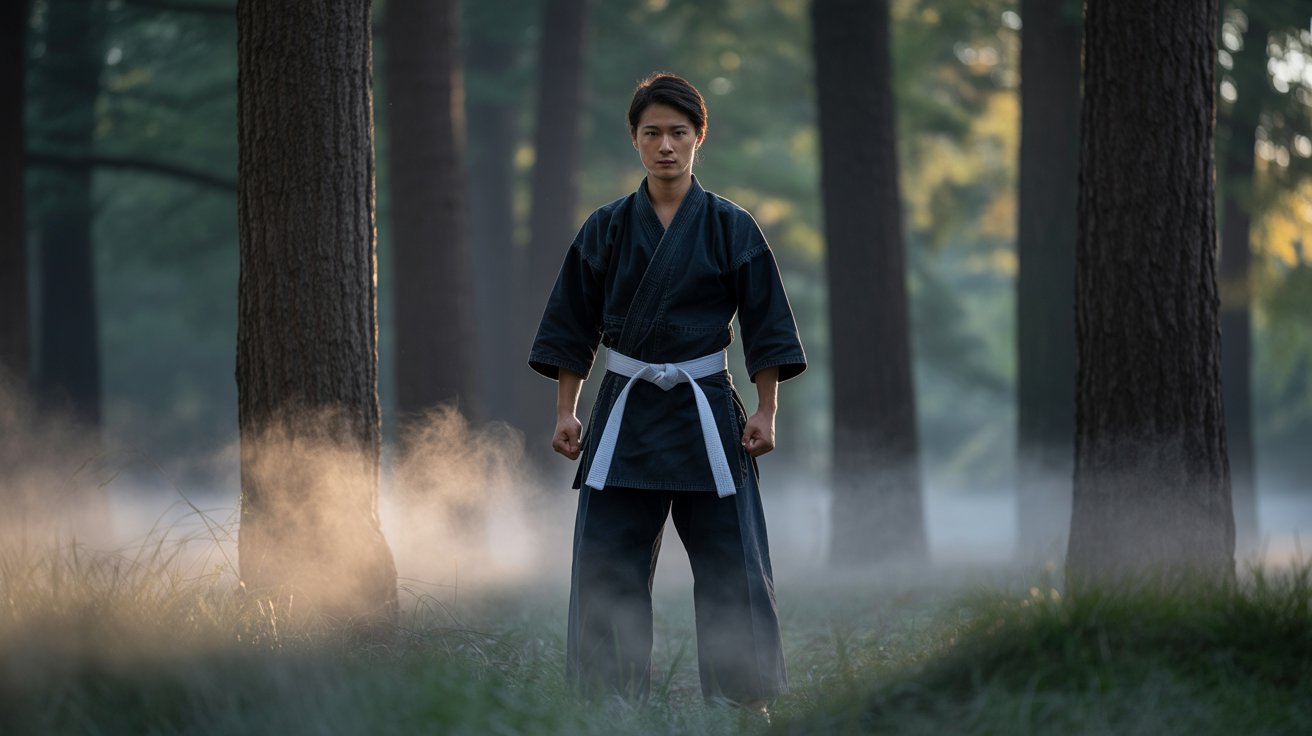
There’s a moment—usually quiet—when someone realizes they don’t want the fantasy anymore. They want the truth. That moment is often what leads people to search for the ninjutsu black belt training path.
Not the costume. Not the rank. The path.
Because real ninjutsu training doesn’t announce itself loudly. It works slowly, patiently, reshaping how the body moves and how the mind reacts when things stop going according to plan.
A black belt in ninjutsu isn’t a finish line. It’s a point of no return.
What a Ninjutsu Black Belt Really Means
In legitimate systems, a black belt doesn’t say “I’ve mastered this.” It says something far more specific: I’ve built a body and mind capable of learning correctly from here on.
Traditional ninjutsu was never obsessed with outward symbols. Survival doesn’t care about color or rank. What mattered—and still matters—is whether movement holds up under pressure.
That’s why instructors often treat black belt candidates with more scrutiny, not less. Responsibility increases as rank rises.
The Ranking Structure (And Why It’s Misunderstood)
The early stages—the kyu ranks—are where most people struggle without realizing it. You’re not collecting techniques; you’re dismantling habits. Poor posture. Tension. The instinct to force outcomes.
Ukemi becomes second nature. Falling stops feeling like failure. The body learns how to yield without collapsing.
Black belt marks the transition into dan ranks, where techniques are no longer taught as sequences but as expressions of principle. You’re expected to adapt—not imitate.
Skill Development That Actually Matters
Ninjutsu doesn’t reward rigidity. It rewards awareness.
Body conditioning isn’t about toughness—it’s about durability. Joints aligned. Breath steady. Impact absorbed without panic. When things go wrong, the body doesn’t freeze.
Taijutsu teaches you to arrive before danger fully forms. Distance, timing, and angle matter more than speed. You stop reacting and start positioning.
Stealth, at higher levels, stops being about hiding and starts being about perception. Where attention goes. Where it doesn’t. And how to move within that gap.
Weapons Aren’t Extras — They’re Teachers
Weapons training exists to refine understanding, not to decorate skill. A stick teaches structure. A sword teaches consequence. Flexible weapons teach chaos.
If your movement changes completely once a weapon enters your hands, the lesson hasn’t landed yet. Integration is the goal.
The Mental Side No One Can Fake
Progress on the ninjutsu black belt training path quietly rewires temperament. Frustration loses its grip. Ego becomes noisy—and therefore easy to spot.
You learn patience because rushing simply doesn’t work. You learn calm because tension gives you away. Awareness stops being situational and becomes continuous.
This is the part that makes people either stay—or disappear.
How Long the Path Really Takes
Honest timelines matter. Most legitimate paths fall between three and five years of consistent training. Faster often means thinner skill. Slower often means deeper roots.
Shortcuts don’t fail immediately. They fail later—when pressure reveals what was never built.
Finding the Right School
Authentic schools don’t promise results. They promise work.
If rank is emphasized more than movement quality, that’s a signal. If lineage can’t be explained clearly, that’s another. Real instructors talk less about belts and more about fundamentals, patience, and responsibility.
Products / Tools / Resources
-
Traditional training uniforms (durable, unrestricted movement)
-
Hanbō or bō staffs for foundational weapons practice
-
Conditioning tools for joint stability and mobility
-
Books on classical budō philosophy and mindset development
- Authentic online training courses